

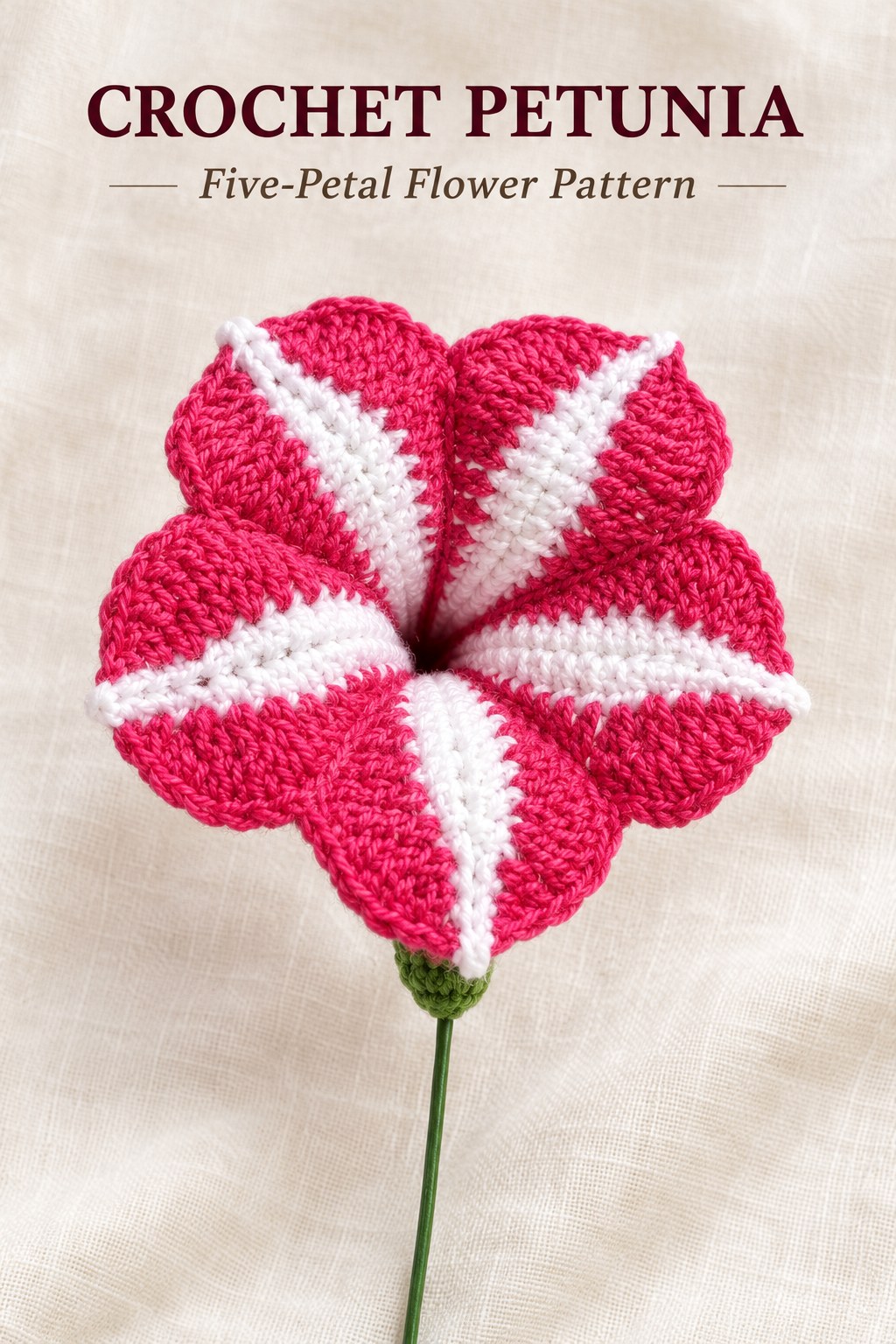
This crochet Petunia pattern builds a five-lobed flower from five individually worked petals joined along their sides. It follows PDF pages eighty-one and eighty-two of the supplied collection. The first finished example has a white star-like stripe across a dark-pink flower face. The second adds an extra upper edging after the same petal and base construction. This guide retains both finishes, the twelve-stitch joining path, the shaped fifteen-to-five-stitch base and the source wire installation, with the original charts and actual assembly photographs.

Key Takeaways
- Use white, dark-pink and green cotton with a 1.90 mm hook.
- Make five separate petals beginning with fifteen chains.
- The source MD stitch is charted with two bars and is translated here as US treble crochet.
- Join petal sides with twelve single crochets, turn and return with twelve slip stitches.
- The five base arches provide fifteen single crochets, reduced to ten and then five.
- Flower 2 adds a separate upper edging; support either version with the listed 0.8 mm green wire.
CROCHET PETUNIA FLOWER PATTERN
Project: A five-petal joined Petunia with shaped base and two source finishes, one plain at the rim and one with an additional upper edging.
| Skill level | No individual rating is given. Uses working around chains, tall-stitch increases, joined seams and base shaping. |
|---|---|
| Yarn and hook | Cotton yarn in white, dark pink and green; 1.90 mm crochet hook. Yarn weight, brand and quantity are unspecified. |
| Support and measurements | Green wire 0.8 mm in diameter. Cut length, finished size and gauge are not supplied. |
| US abbreviations | ch chain; sc single crochet; hdc half double crochet; dc double crochet; tr treble crochet; ss slip stitch. Source ST means ss; source MD matches the two-bar tr chart symbol. Together means complete stitches in one original unless another operation is stated. |
| Petals, make 5 | Begin ch15. |
| Petal round 1 | Ch1, 5 sc, 5 hdc, 10 sc, 5 hdc, 5 sc, ch2, following the chart around both sides of the foundation. |
| Petal round 2 | Sc, dc, 3 times, 5 dc, 5 sc, ch2, 5 sc, 5 dc, 3 times, dc, sc. Cut and tie the knot. |
| Flower 1, joining round 3 | Join yarn at a petal base. Repeat around the five petals: 3 sc into the base ch2 arch; join the next petal with 12 sc, turn and work 12 ss back along the joining path. Follow the source chart and seam photos. |
| Flower round 4 | 15 sc at the base. |
| Flower round 5 | 5 times: 10 sc. |
| Flower round 6 | 5 times: 5 sc. Tighten with ss, lock ch2, cut yarn. |
| Flower 2 | Use the same petals and joining/base rounds as Flower 1, then add the next edging round at the upper flower. |
| Flower 2 upper round 7 | Repeat around the upper flower: 2 sc, 2 dc in one original, 2 dc in next original, 2 sc, 3 dc in one original, 2 sc, 2 dc in one original, 2 dc in next original, 2 sc. Ss join, cut and tie. |
| Wire and assembly | Insert the wire up and down along one side of the flower. Fold the upper wire and lock it at the base, as the source process photograph shows. |
Understand the Five Separate Petals
Each petal begins as a narrow chain-based component. Its white central strip and wider dark-pink upper area combine into the star-like appearance when five are joined. The petals are not five independent flowers attached to a center ring; their side seams create one shared funnel-shaped bloom.
The written rounds name the palette but do not spell out every color join. Use the finished photograph and original diagrams to guide a matching white-and-pink arrangement. Keep any chosen joining method or exact color boundary distinct from a separately printed color-change instruction. The component counts and stitch sequence remain the source method.
Materials and Source Terminology
The source specifies cotton in white, dark pink and green, a 1.90 mm hook and green wire 0.8 mm in diameter. It supplies no yarn weight, yardage, gauge, wire-cut length or finished flower measurements. Choose the cotton and assess the resulting fabric rather than inventing a promised diameter from the scanned photograph.
The general collection legend uses US single, half double, double and treble crochet. ST is its abbreviation for slip stitch. The text’s MD labels correspond to two-bar tall symbols on the Petunia chart, matching US trebles. This chart-based translation preserves the taller upper shaping instead of silently replacing those stitches with ordinary doubles.
Two or three stitches together in this chapter means complete stitches placed in the same original. It is an increase or fan, not a decrease. This meaning is especially important for the petal’s treble pairs and Flower 2’s double-crochet edging. Complete each stitch before beginning the next in its shared anchor.
Chart checkpoint: MD is translated as US treble from the two-bar symbol. Two stitches together share one original and increase the count; they are not worked as a shared-top decrease.
Petal Foundation and First Round
Begin fifteen chains for one petal. The first round is chain one, five single crochets, five half doubles, ten single crochets, five half doubles, five single crochets and chain two. Follow the chart around both sides of the original foundation so the paired lower and upper areas stay aligned.
The ten-single-crochet portion spans the far-end portion of the narrow component. Keep the taller half doubles through the middle sections and the short singles toward the ends. The two-chain space at the lower base is retained for the later three-single-crochet attachment. Do not bind that arch closed with an added seam.
Work all five components using the same foundation and first-round sequence. Their joined edges need matching stitch paths. A petal made from another chain length may look similar on its own but will not automatically match the source’s twelve-stitch side seam or three-stitch base contribution.
Second Round: Widen the Tall Upper Portion
Work one single crochet, one double crochet and three treble increases, with each increase placing two full trebles in one original. Continue with five doubles and five singles, then chain two. Work the return side as five singles, five doubles, three treble increases, one double and one single.
Cut the yarn and tie the knot after the complete petal round. The two halves mirror the listed stitch-height progression, while the middle chain space marks the far end. Keep the two trebles of every increase together in their charted anchor instead of distributing them over two originals.

Prepare All Five Petals before Joining
The source explicitly asks for five petals. Compare their foundations, tall upper sections and base arches before starting the joining round. The finished striped photograph is useful for the relative placement of the central light strip and surrounding dark pink, while the petal chart establishes the stitch path.
Keep the same orientation on each piece when laying out the flower. The narrow bases point toward the eventual throat, and the broader ends form the five-lobed rim. No sixth component or separately worked center disc appears in the source Petunia construction.
Construction Note
Five petals become one flower through side seams. Their five two-chain base arches contribute three single crochets each, producing the fifteen-stitch base that is narrowed in the following rounds.
Join Yarn at the Petal Base
Join the yarn at a petal base and work three single crochets into its two-chain arch. This is the base contribution for that petal. The next operation joins the neighboring petal with twelve single crochets along the side path shown in the process photographs.
Keep the base arch and joining side distinct. The three singles will be available around the flower’s bottom, while the side seam connects the petal bodies above. Do not work fifteen singles into a single arch or replace the side seam with a few uncounted sewing stitches.
Work the Twelve-Stitch Seam and Return
Join the next petal by working twelve single crochets along the adjoining side edges. Turn and work twelve slip stitches back along that joining path. The source repeats this pair of seam passes as the remaining petals are incorporated, with three singles worked in each base arch.
The return pass is a slip-stitch path, not another row of taller stitches. It brings the working yarn back toward the base before the next petal is added. Retain all twelve on the outward join and all twelve on the return, following the actual chart and close source photographs rather than guessing a different seam length.
Joining checkpoint: Twelve single crochets join the side, and twelve slip stitches return along it. Preserve each three-single-crochet base arch for the circular shaping that follows.
