

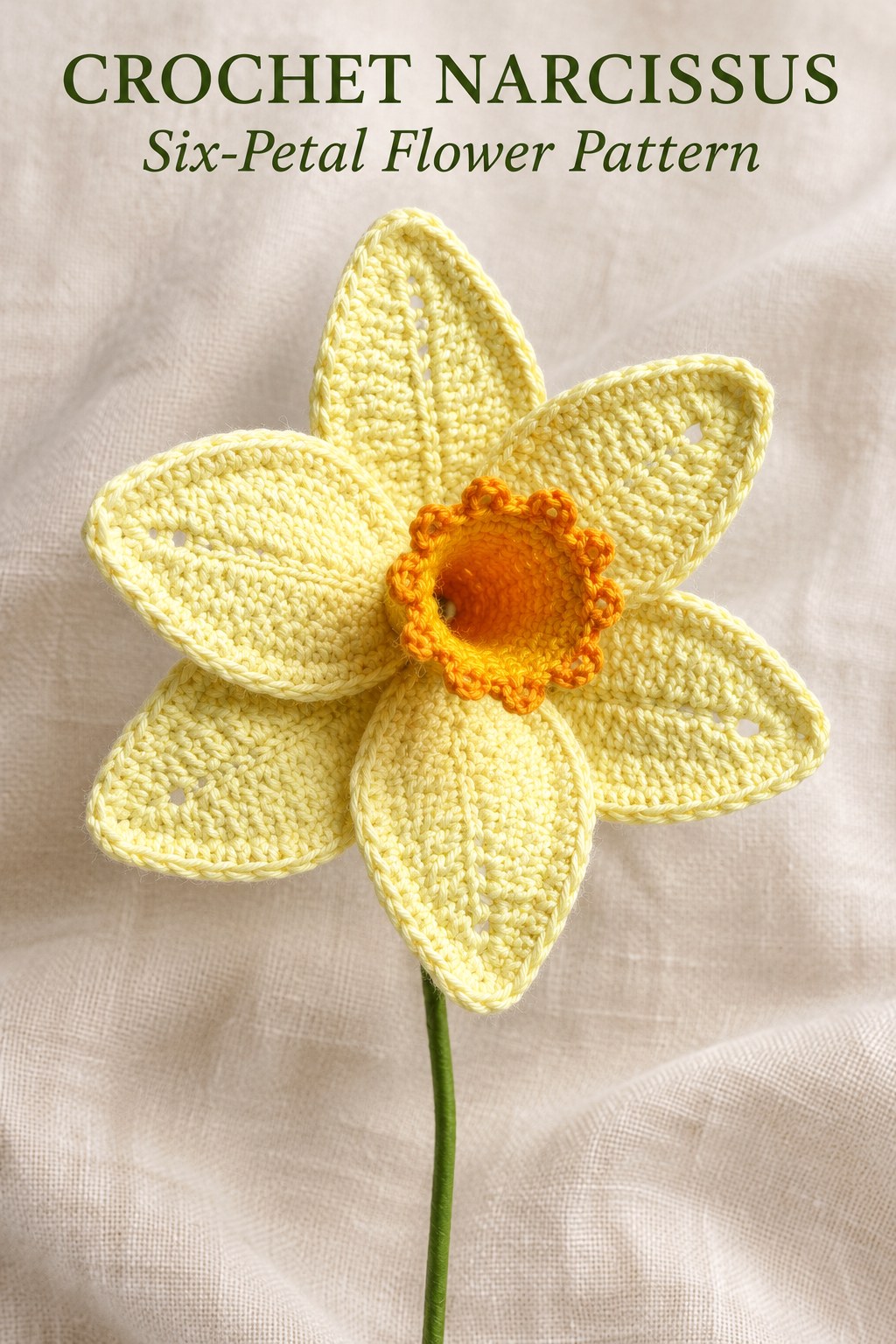
This crochet Narcissus pattern makes six light-yellow wired petals around a separate raised trumpet corolla. It follows the design on PDF pages one hundred and five and one hundred and six of the supplied collection. Each petal is formed around a narrow fifteen-stitch foundation strip and enclosed by a wired single-crochet edge. The corolla develops from ten to twenty stitches through plain tubular sections before its scalloped rim. This guide keeps the full source sequence, chart-based stitch meanings and actual assembly photographs, without adding an unlisted leaf or stamen component.

Key Takeaways
- Make six separate wired petals and one trumpet corolla.
- Use cotton in orange, yellow and light yellow with a 1.90 mm hook, 0.6 mm wire and green floral tape.
- The petal begins with fifteen working chains plus one height chain.
- The source abbreviation MD matches its chart’s two-slash treble symbol, so this guide uses US tr.
- Two single crochets together means an increase in one original in this chapter, not sc2tog.
- Join the petal wires, insert the separate corolla through the flower center, twist the support and tape the stem.
CROCHET NARCISSUS FLOWER PATTERN
Project: Six wired oval petals surround one crocheted trumpet with a small scalloped rim. The source supplies the component charts and wire assembly photographs.
| Skill level | Not explicitly graded for this entry. Uses several stitch heights, same-stitch increases, wired edges and a separate tubular corolla. |
|---|---|
| Yarn and hook | Cotton yarn in orange, yellow and light yellow. Crochet hook 1.90 mm. Formal yarn weight, quantity, gauge and finished dimensions are not supplied. |
| Support | Wire 0.6 mm and green floral tape. No required wire-cut length is given. |
| Color placement | The photograph shows light-yellow petals with a deeper yellow/orange trumpet. The prose lists the palette but does not provide a numbered color-change schedule. |
| US abbreviations | ch = chain; sc = single crochet; hdc = half double crochet; dc = double crochet; tr = treble crochet; ss = slip stitch. Source MD is identified by the chart as tr; source ST means ss. Inc means 2 complete stitches in one original. |
| Petal foundation, make 6 | Ch15 plus 1 height chain. Work 15 sc across the working chains. |
| Petal round 2 | Work around the narrow strip: 3 sc, 3 dc, tr inc 3 times, 3 dc, 6 sc, 3 dc, tr inc 3 times, 3 dc, 3 sc. Follow the source oval chart around the two sides. |
| Petal round 3 | Work sc around the edge while incorporating wire. Twist the wire and ss join. Ch2 to lock and cut the yarn. Complete 6 petals. |
| Corolla foundation and round 1 | Magic ring; ch3, 10 dc into the ring. Tighten and ss join. |
| Corolla round 2 | around, 5 groups. 15 sc. |
| Corolla rounds 3–8 | 15 sc each round for 6 rounds. 15 working stitches; 90 sc worked in total across this section. |
| Corolla round 9 | around, 5 groups. 20 sc. |
| Corolla rounds 10–11 | 20 sc each round for 2 rounds. 20 working stitches; 40 sc worked across the section. |
| Corolla round 12 | around, following the chart’s paired edge anchors. The 20-stitch edge gives 10 chain-loop scallops. |
| Corolla finish | Ch2 to lock, cut the yarn and turn the corolla inside out. Insert wire at its bottom and twist. |
| Assembly | Join the 6 petals by twisting their wires. Insert the separate corolla at the flower center and twist its support with the petal wires. Cover the stem with green floral tape. |
Read the Source’s Increase and Stitch-Height Legend
The general legend on PDF page sixty-nine is essential for this chapter. Its two single crochets together label refers to two complete singles placed in one original stitch. That is an increase, not the familiar US sc2tog decrease. The trumpet’s fifteen- and twenty-stitch counts confirm this meaning.
The petal text also uses MD without defining that abbreviation in its prose. Its diagram shows the same two-slash stitch symbol that the legend calls triple crochet. This guide therefore uses the US treble crochet abbreviation tr for those positions, keeping the actual charted stitch height rather than guessing from the unfamiliar letters alone.

Prepare Six Petals and One Separate Trumpet
The source explicitly calls for six petals. Work them separately, adding wire to each outer edge, then join their supports during assembly. The trumpet, called the corolla in the source, is a different component that is inserted after the six-petal flower has been organized.
The finished photograph shows the trumpet raised above the petal center. It is not a flat crocheted ring, a bead or a wrapped-wire loop. Keep the separate tubular construction and the later inside-out turn, which belong to this source design rather than substituting another flower center from the collection.
Gather the Cotton, Hook, Wire and Floral Tape
The written materials are cotton yarn in orange, yellow and light yellow, a 1.90 mm crochet hook, 0.6 mm wire and green floral tape. The source gives no formal yarn-weight category, brand, quantity, gauge, finished bloom diameter or wire-cut length.
Choose the actual cotton and assess its stitch definition on the stated hook. The source photograph suggests pale petals and a deeper yellow/orange trumpet, but the prose does not specify a numbered color-change schedule. Use the photograph for that placement without presenting an invented transition round as a printed requirement.
No leaf, separate stamen, stuffing or adhesive component is listed. The supporting wires and floral tape form the stated attachment and stem finish. Do not add a green crochet leaf or a filled trumpet simply because those elements appear in other Narcissus or daffodil designs elsewhere in the file.
Component checkpoint: Make six individual wired petals and one separate corolla. The raised trumpet is crocheted and later turned inside out before assembly.
Petal Foundation: Fifteen Working Chains plus One
For one petal, begin with fifteen chains plus one height chain. Work fifteen single crochets along the working foundation. This forms the narrow strip around which the next round develops the broader oval shape shown in the source diagram.
Keep the height chain separate from the fifteen working positions. The next instruction continues around the strip’s two sides, so do not replace the foundation with a longer chain merely because the following stitch list includes both halves of an oval. Use the diagram to retain the original central line.
Petal Round 2: Build the Taller Middle Sections
Work three singles, three doubles and three treble increases, then three doubles and six singles. Continue around the other side with three doubles, three treble increases, three doubles and three singles. Each treble increase places two complete trebles into one original position.
The taller stitches create the wider petal body, while the single-crochet sections narrow its ends. Follow the source’s oval path around both sides of the narrow foundation strip. This is not an instruction to work the entire list across only the fifteen top loops as an ordinary straight row.
The diagram supplies the two-sided layout and tapered ends. Keep the first and final three-single sections and the six-single turning section as shown rather than distributing all singles evenly around a circular disc. Those placements distinguish the elongated Narcissus petal from a round flower motif.
Petal Round 3: Enclose the Wire with Single Crochet
Work single crochet around the edge while incorporating wire. The source process photo shows the support being enclosed as the outer edge is made. Keep the wire following the petal perimeter without stitching it through the visible middle chain line.
Twist the support wire, join with a slip stitch, chain two to lock and cut the yarn. No separate numerical outer-round count is printed. Retain the source’s instruction to work around the edge rather than assigning a guessed count from the photograph or adding an extra increase round.
Complete and Compare All Six Petals
Repeat the full petal sequence until six pieces are ready. Compare their foundation lengths, taller stitch groups and wired outlines before joining them. Similar edge shaping helps the six petals sit together around the central trumpet, but no measured petal width is supplied.
The wire remains part of each completed petal. The source supplies its diameter but not an exact allowance beyond the crocheted edge. Keep enough support for the photographed joining method, identifying that allowance as a working choice rather than a printed stem measurement.
Two Different Supports
Each petal has its own wire-enclosed edge. The corolla receives separate wire at its bottom. These supports are joined only after the six petals and the turned trumpet are complete.
Corolla Round 1: Begin with Ten Doubles
Make a magic ring, chain three and work ten double crochets into it. Pull the loose end to tighten and join with a slip stitch. Keep ten actual working double crochets identifiable for the next increase round, separate from the starting chain rise.
The source uses this small circular start for the base of the trumpet. It does not instruct beginning from a long chain loop or stuffing the base. Follow the ten-stitch foundation before increasing into the plain tubular section.
Corolla Round 2: Increase Ten to Fifteen
Repeat a single-crochet increase followed by one plain single around the ten originals. Five two-position groups produce fifteen singles. Work both complete stitches of each increase into the same original, using the source legend’s meaning of together.
If the cup narrows at this stage, review the increase definition before continuing. A joined-top decrease would remove stitches instead of adding five. The fifteen count is the circumference held throughout the six plain rounds that follow.
