

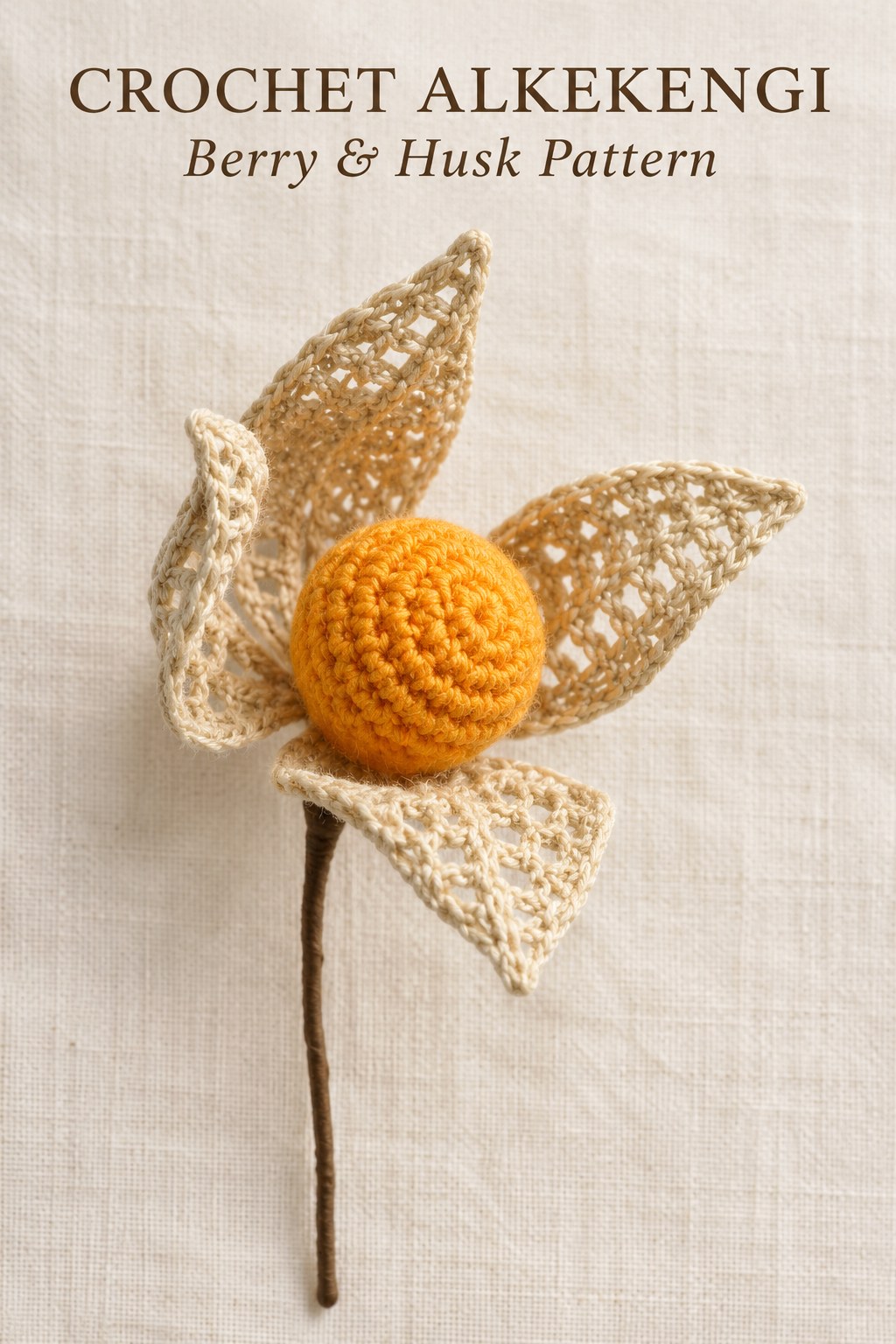
This crochet Alkekengi pattern makes an opened husk ornament with a light-orange stuffed center, four beige wired leaves and a brown-taped stem. It follows the one-page design on PDF page 118 of the supplied collection. The rounded center is labeled the base in the source and grows from five to twenty single crochets before narrowing. Four elongated leaves are worked around a chain foundation and supported with wire. This guide preserves the full base sequence, the leaf chart and the photographed component-and-wire assembly without adding unlisted parts.

Key Takeaways
- Use beige and light-orange cotton with a 1.90 mm hook.
- The source specifies 0.6 mm wire, stuffing and brown floral tape.
- The base count grows five, ten, fifteen and twenty, holds twenty for three rounds, then narrows fifteen, ten and five.
- The final base stage makes a short three-single-crochet chain extension.
- Make four beige wired leaves using the two paths in the source chart.
- Join the base and leaf supports by twisting their wires, then cover the stem with brown floral tape.
CROCHET ALKEKENGI PATTERN
Project: One light-orange stuffed base surrounded by four beige wired husk leaves, joined to a brown-taped supporting stem.
| Skill level | No individual rating is supplied. Uses small shaped rounds, skipped-position reductions, crochet around a chain and wired assembly. |
|---|---|
| Yarn and hook | Cotton yarn in beige and light orange. 1.90 mm hook. Formal yarn weight, brand and quantity are unspecified. |
| Support and extras | 0.6 mm wire, stuffing and brown floral tape. Wire cut length and stuffing quantity are not stated. |
| Size and gauge | No finished berry diameter, leaf dimensions, stem length or gauge is supplied. |
| US terminology | ch = chain; sc = single crochet; dc = double crochet; tr = treble crochet; ss = slip stitch. Source st means ss. Source MD maps to US tr by the two-bar chart symbol. Two sc together means 2 complete sc in the same original, not a decrease. |
| Base round 1 | With light orange, make a magic ring and work 5 sc. Tighten. |
| Base round 2 | 2 sc in each original. 10 sc. |
| Base round 3 | 5 times. 15 sc. |
| Base round 4 | 5 times. 20 sc. |
| Base rounds 5–7 | 20 sc for each of 3 rounds. Twenty working stitches remain; sixty sc are worked across the three rounds. |
| Base round 8 | 5 times. 15 sc. Add stuffing. |
| Base round 9 | 5 times. 10 sc. |
| Base round 10 | 5 times. 5 sc. |
| Base stage 11 | Ch3 plus 1 height chain, work 3 sc back along the short chain and join with ss at the extension base, following the source chart. The source calls this its eleventh-round finish. |
| Leaf foundation, make 4 | With beige, ch15, then the source’s ch1 height allowance for the first path. |
| Leaf path 1 | 3 sc, 3 dc, 3 tr, 3 dc, 6 sc around the far end, 3 dc, 3 tr, 3 dc, 3 sc. The source chart distributes the thirty stitches around both sides of the chain. |
| Leaf path 2, incorporate wire | 15 sc, then ch2 plus 1 height chain and work 2 sc back along that extension; continue with 15 sc. Make 4 supported leaves. |
| Assembly | Insert wire at the top of the base and twist it. Join the base and four leaves by twisting their supporting wires together. Cover the stem with brown floral tape. The source does not add a bead, flower rod, adhesive or an extra crocheted foliage component. |
Understand the Base and Four-Leaf Husk
The light-orange rounded piece is called the base in the source. In the finished ornament it appears as the exposed berry inside the opened beige husk. The four surrounding components are labeled leaves, even though their display role is the husk around the center.
Keep those source labels clear while working. The component photograph shows four separate beige pieces around the orange base before assembly. In the completed view, some overlap or sit behind the center, so the photograph alone should not be used to reduce the written four-leaf quantity.

Gather Cotton, Wire, Stuffing and Brown Tape
The material list names cotton yarn in beige and light orange, a 1.90 mm crochet hook, 0.6 mm wire, stuffing and brown floral tape. It does not specify a formal yarn weight, brand, quantity, wire-cut length or a measured amount of filling.
Choose the actual cotton and assess its single-crochet fabric on the stated hook. The orange center should use the source’s shaped-round sequence rather than an independently crocheted flat disc. No exact finished diameter or gauge is provided from which to predict its dimensions in another yarn.
The brown tape covers the combined wire support after assembly. The method does not list a flower rod, hot-melt adhesive, pearl or additional backing. Keep those supplies separate from the ones used by other patterns in the collection, even when they share a wire-supported construction.
Read the Chapter’s Increase and Skip Wording
The general legend defines two single crochets together as two complete singles in one original. It is an increase, not sc2tog. The base’s five-to-ten-to-fifteen-to-twenty count progression confirms that reading. Work both singles fully before moving to the next original.
The narrowing rounds explicitly skip one original and work the named number of singles afterward. Those are skipped-position reductions rather than single-crochet-two-together decreases. Preserve that method instead of silently substituting a different decrease because it also produces a smaller count.
Terminology checkpoint: Increases are complete pairs of singles in one original. The narrowing rounds skip a position; they do not use an unprinted sc2tog substitution.
Base Rounds 1–2: Expand Five to Ten
With light-orange cotton, make a magic ring and work five single crochets. Pull the loose end to tighten the ring. In round two, work two singles in every original, giving ten. The five original positions each contribute two complete new stitches.
Keep the ring count and the next round’s increase count separate from any joining or starting loop. The source does not specify an extra counted chain in these first rounds. Check ten before continuing to the alternating increase-and-single sequence.
Base Rounds 3–4: Reach Twenty
Round three repeats two singles in one original followed by one single in the next, five times. Ten incoming positions become fifteen. Round four repeats two singles in one original followed by one in each of the next two, five times, bringing fifteen to twenty.
Each of these rounds adds five. The plain run between increases grows from one single to two while the number of repeat groups stays at five. If the count narrows instead, review the source’s unusual together wording before continuing the body.
Base Rounds 5–7: Hold Twenty for Three Rounds
Work twenty single crochets in each of rounds five, six and seven. The source also writes sixty singles for the three rounds combined. Twenty remains the working circumference throughout; no further increase is made during this section.
The chart highlights the plain section and says to work it three times. Keep that three-round tally separate from the circumference count. Working sixty stitches as one enlarged round would change the center into a different shape and break the later five-group narrowing sequence.
Base Count Note
The orange piece progresses 5 → 10 → 15 → 20, holds 20 for three rounds, then narrows 20 → 15 → 10 → 5. Stuffing is added after the first narrowing round.
Round 8: Narrow to Fifteen and Add Stuffing
Skip one original and work three singles in the next three, repeating five times. Twenty incoming positions produce fifteen singles. Add stuffing at this point, as the source places the filling instruction after round eight.
The source gives no weight or volume of stuffing. Assess the filling in the actual fabric you have made without forcing it between the stitches. Keep the opening accessible for the remaining narrowing stages instead of inventing an earlier sealed closure.
Rounds 9–10: Narrow to Five
Round nine skips one original and works two singles, repeated five times, reducing fifteen to ten. Round ten skips one and works one single, repeated five times, reducing ten to five. These groups use their incoming positions exactly.
Keep the working count at five before the small terminal extension. The source does not prescribe a separate drawstring through those five or an ordinary five-stitch cast-off. Follow its short extension and supporting-wire assembly rather than adding a replacement finish as though it were printed.
Stuffing checkpoint: Add filling after round eight at fifteen stitches, then complete the ten- and five-stitch narrowing rounds before the short terminal extension.
