

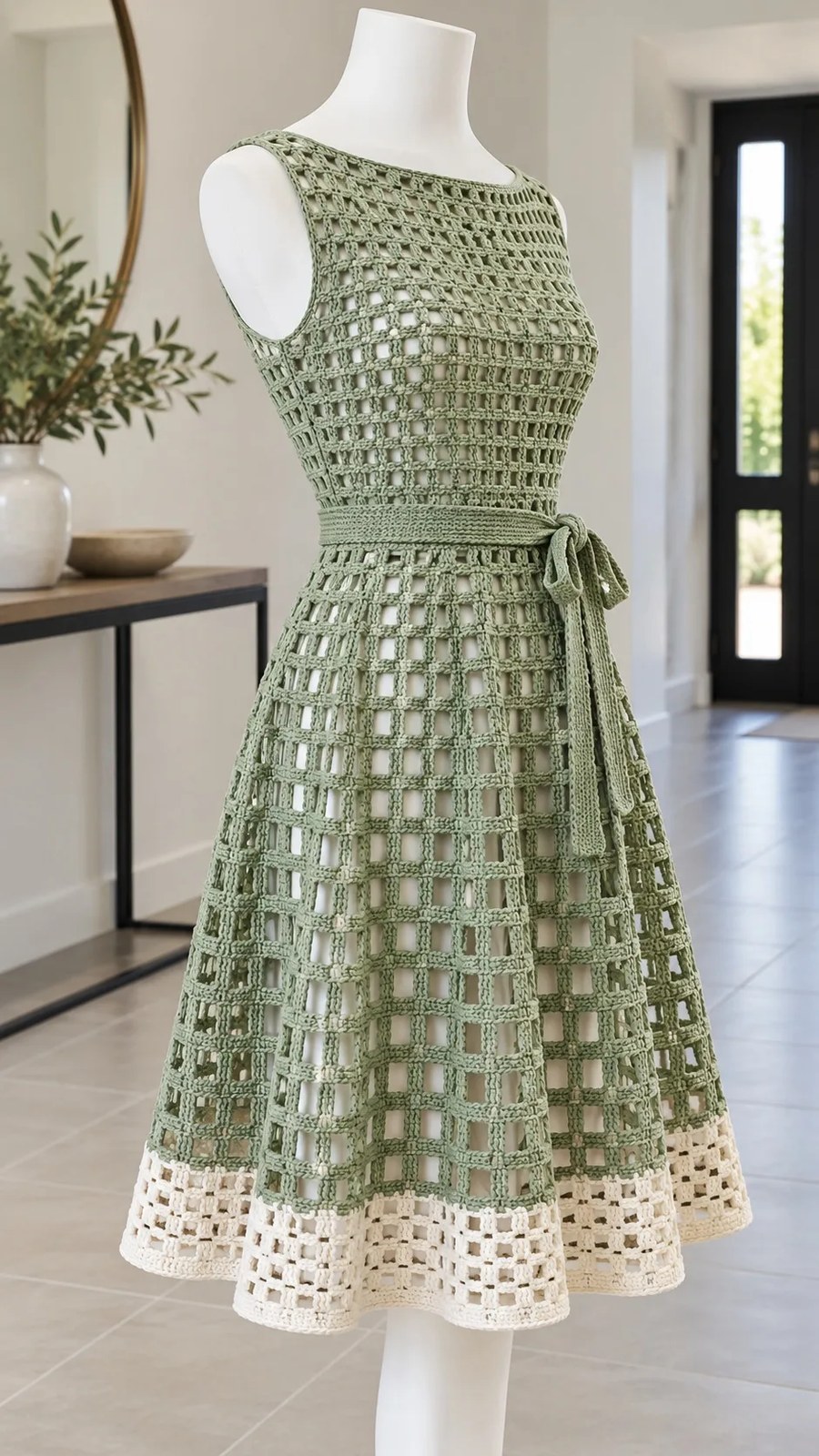
This is THE dress pattern you’ve been waiting for. Seriously impressive, absolutely stunning on the hanger, and the kind of project that makes everyone ask “you MADE that?!” The lattice checker stitch creates those gorgeous open windows that catch the light beautifully, while the A-line skirt gives you that perfect garden party silhouette.
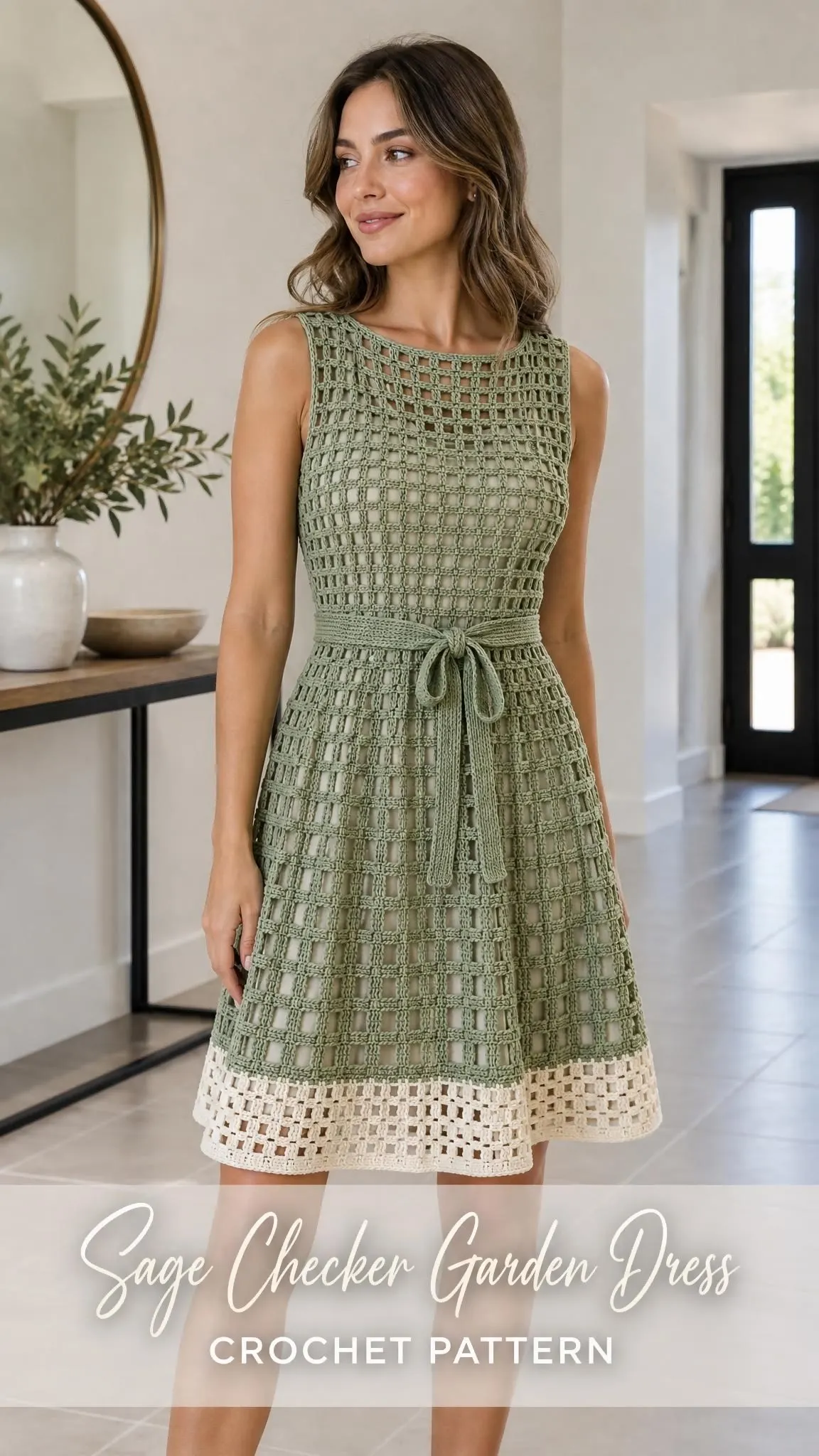
The construction is smarter than it looks. You’re working flat panels and joining them, which means no wrestling with massive rounds or complicated shaping. The bodice and skirt are separate pieces that come together at the waist, giving you control over fit every step of the way. Plus, that ivory hem band adds the perfect finishing touch without any fussy colorwork techniques.
If you’ve been wanting to tackle a garment but felt intimidated, this checker lattice stitch is actually quite rhythmic once you get going. The pattern uses a simple repeat of double crochet (dc) blocks alternating with chain-3 windows. Once your hands learn the rhythm, you’ll find yourself flying through rows.
About This Design
The Sage Checker Garden Dress features a boat neckline that’s both elegant and forgiving for fit, a sleeveless bodice that keeps you cool, and a knee-length A-line skirt that moves beautifully when you walk. The sage green main color paired with an ivory hem band creates a fresh, sophisticated look perfect for spring and summer occasions.
This dress is worked as flat panels: two bodice pieces (front and back) and six skirt panels. The panels are blocked and then assembled, which makes the construction much more manageable than working a dress in the round. A side zipper allows for easy dressing, and the sage tie belt cinches the waist to your perfect fit.
Skill level: Intermediate to advanced. You should be comfortable with double crochet, working from written patterns, and basic garment assembly including seaming and zipper installation.
Materials You’ll Need
Yarn:
- Main color (sage): 698 g (approximately 2094 m) of smooth sport-weight cotton, around 300 m per 100 g
- Accent color (ivory): 200 g (approximately 600 m) of the same yarn weight
The amounts listed include a planning allowance. Weigh your swatch to confirm you have enough yarn before starting.
Hooks:
- 3.5 mm hook for the main fabric
- 3.0 mm hook for firm borders and the belt
Adjust hook size as needed to meet gauge.
Notions:
- Tapestry needle
- Removable stitch markers
- Tape measure
- Scissors
- Blocking mats and rust-resistant pins
- Sewing needle and matching thread
- 40 cm dress zipper
- 1 m of 10 mm cotton tape (to stabilize the waist seam)
- Optional: 6 mm sew-on pearls for layered flowers
Important: This is an openwork dress. You’ll need a separate opaque slip for wearing.
Gauge
Blocked main-stitch gauge: 4 lattice repeats and 10 rows = 10 x 10 cm
One repeat measures approximately 2.50 cm wide. Measure away from edges on your blocked swatch. This gauge governs every count in the pattern, so take the time to get it right.
Swatch instructions: Work the stitch recipe with N = 8 (that’s 8 horizontal repeats). Work at least 20 rows. Wet-block your swatch, dry it flat for 24 hours, then hang it for 12 hours to check for cotton growth. Measure the central 10 cm and recheck after hanging. Keep your swatch for washing and colorfastness tests.
Border gauge: 20 single crochet (sc) and 24 sc rows = 10 cm
Finished Measurements
- Finished bust: approximately 100 cm
- Intended body bust: 90-94 cm with 6-10 cm ease
- Untied waist: 100 cm, cinched with belt to 80-90 cm
- Skirt length: 58 cm
- Bodice shoulder-to-waist: 40 cm
- Sleeves: none (sleeveless version)
Before proceeding, compare these measurements to a well-fitting garment. This is a single-size pattern. Larger size adjustments require a new swatch and recalculated repeats.
Abbreviations and Special Stitches
- ch = chain
- sc = single crochet (insert hook, yarn over, pull through, yarn over, pull through both loops)
- dc = double crochet (yarn over, insert hook, yarn over, pull through, yarn over, pull through 2 loops twice)
- sl st = slip stitch
- st(s) = stitch(es)
- sp = space
- RS/WS = right side/wrong side
- BLO = back loop only
- rep = repeat
- N = number of horizontal motif repeats in a piece
Understanding the Lattice Repeat
One lattice repeat = ch 3 followed by 3 dc. Each row starts with one edge dc.
A row with N repeats contains 3N+1 dc and N ch-3 spaces. The beginning ch 3 counts as the first dc. Keep your blocks positioned above blocks to form square window columns.
The Stitch Recipe
Foundation: Ch 6N+4.
Row 1 (Foundation row):Dc in fourth ch from hook; N times. The skipped three turning chains do not count on this foundation row.
Count: 3N+1 dc and N spaces.
Row 2 and all plain rows:Ch 3, turn, skip first dc; dc in each of next 2 dc; N-1 times; ch 3, skip last space, dc in final edge dc.
Count: 3N+1 dc, N spaces.
Row 3 (mirror row):Ch 3, turn, skip first edge dc; N times.
Count: 3N+1 dc, N spaces.
Alternate Rows 2 and 3 throughout. Do not mistake a ch-3 window for a turning chain.
Pattern Instructions
Back Bodice
With main color (sage) and 3.5 mm hook, start the foundation with N = 20. Work upward from waist.
Row 1: Work foundation row. Count: 20 lattice repeats.
Rows 2-37: Work the next plain recipe row, alternating Row 2 and Row 3 patterns. Count: 20 lattice repeats per row.
After Row 37, mark the central 8 repeats as the back neck opening. Work the outer 6 repeats at each side separately, restarting yarn at the outer edge or neck edge as required by row direction. Leave the marked center unworked.
Rows 38-40, each shoulder: Continue the recipe over the outer 6 repeats only. Count: 6 lattice repeats per shoulder.
Fasten off with 20 cm tails.
Front Bodice
Begin as back with N = 20. Work one panel (no center front opening).
Row 1: Work foundation row. Count: 20 lattice repeats.
Rows 2-35: Work next plain recipe row. Count: 20 lattice repeats per row.
After Row 35, leave the central 8 repeats unworked. Work each shoulder separately over 6 repeats. This creates the boat neckline.
Rows 36-40, each shoulder: Continue next recipe row over this shoulder only. Count: 6 lattice repeats per shoulder.
