

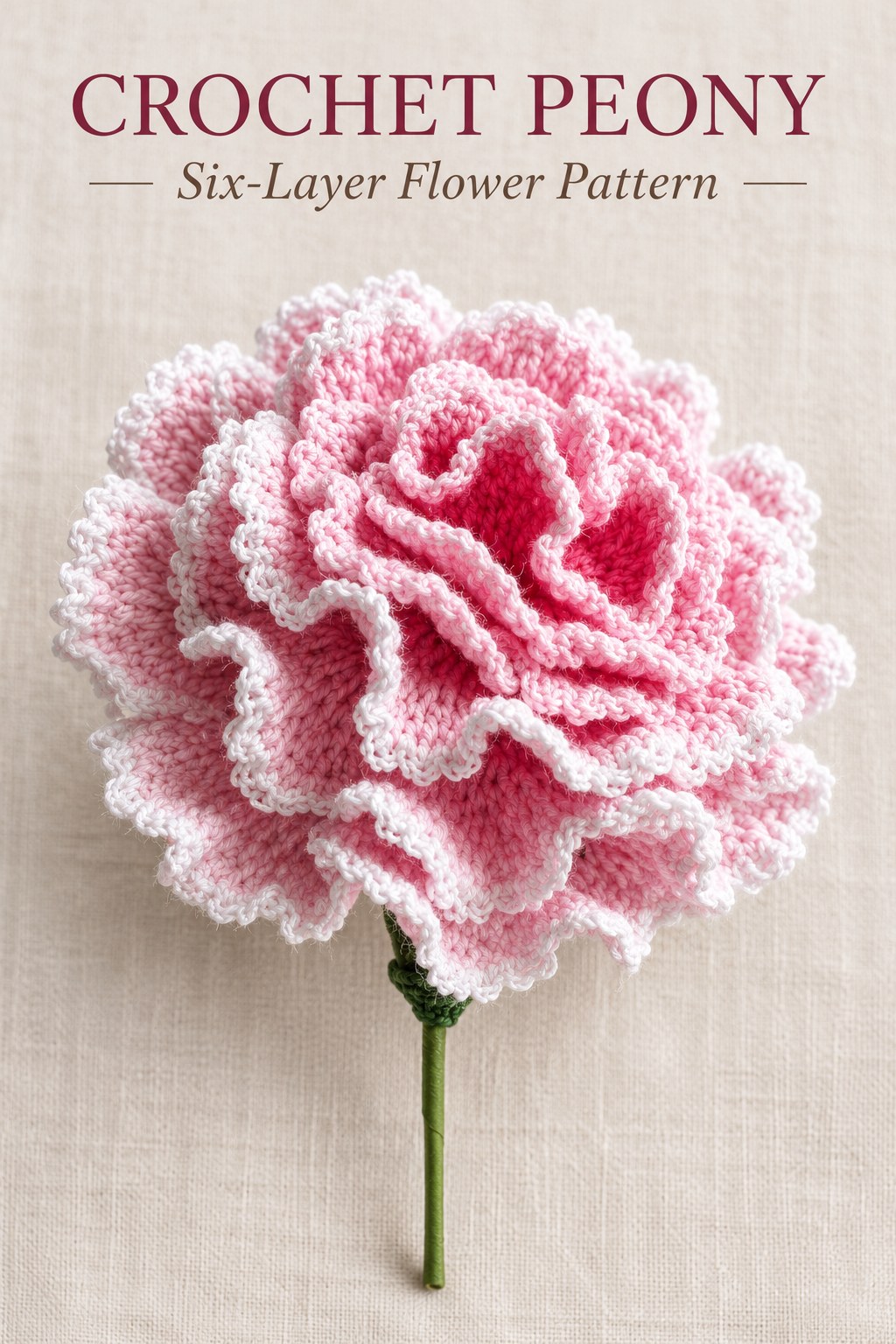
This crochet Peony pattern creates a dense ruffled bloom from six graduated circular motifs nested on wire above a green receptacle. It follows the design on PDF pages ninety-seven through one hundred and one of the supplied collection. The source labels the six flower pieces Petal 1 through Petal 6, but each is a whole circular layer, not one flat botanical petal. This guide retains every round, the original charts and genuine assembly photographs, while translating the source’s same-stitch increase wording into clear US terms.

Key Takeaways
- Make one each of the six graduated circular flower motifs and one receptacle, as shown in the component photograph.
- Use cotton in white, pink and dark pink with the specified 1.90 mm hook; the green wool receptacle uses the listed 3.50 mm hook.
- The source’s “2 dc together” means two complete double crochets in one stitch, not a decrease.
- The printed abbreviation MD is identified by the chart’s two-slash treble symbol; this guide uses US tr.
- The six ruffled outer rounds have derived counts of 32, 32, 48, 64, 90 and 120 before their chain-loop edges.
- Nest the motifs from smallest to largest, add the receptacle, twist the wire and cover the stem with green floral tape.
CROCHET PEONY FLOWER PATTERN
Project: Six nested ruffled circular motifs with chain-loop edges and one green receptacle, supported by wire and a floral-taped stem.
| Skill level | Not explicitly graded beside this design. Requires reading circular charts, same-stitch increases, graduated motifs and wire assembly. |
|---|---|
| Yarn and hooks | Cotton yarn: white, pink and dark pink; 1.90 mm hook. Wool: dark green; 3.50 mm hook. Yarn quantity, formal weight and finished dimensions are not specified. |
| Support materials | 0.8 mm wire and green floral tape. No leaf or separate stamen component is supplied. |
| Color placement | The source photo shows darker pink inside and pale/white loop edging, but the prose does not specify a numbered color-change schedule. Treat that placement as a photographic guide. |
| US abbreviations | ch = chain; sc = single crochet; dc = double crochet; tr = treble crochet; ss = slip stitch. Dc inc = 2 complete dc in one original. The source’s ST is a slip stitch and its MD matches the chart’s treble symbol. |
| Shared twenty-stitch foundation | Magic ring; ch4, 20 tr into the ring, tighten and ss join. This is round 1 of each flower motif. |
| Motif 1 round 2 | around, 4 groups. 32 working stitches. |
| Motif 1 round 3 | around; ss join. Ch2 to secure, cut and knot. |
| Motif 2 round 2 | Ch3, 20 dc, ss join. |
| Motif 2 round 3 | around, 4 groups. 32. |
| Motif 2 round 4 | around; ss join. Ch2, cut and knot. |
| Motif 3 rounds 1–2 | Work the shared foundation, then ch3, 20 dc, ss join. |
| Motif 3 round 3 | Ch3, around. 30 dc. |
| Motif 3 round 4 | around, 6 groups. 48. |
| Motif 3 round 5 | around; ss join. Ch2, cut and knot. |
| Motif 4 rounds 1–3 | As motif 3: shared 20-tr foundation, plain 20-dc round and increase round to 30 dc. |
| Motif 4 round 4 | Ch3, around. 40 dc. |
| Motif 4 round 5 | around, 8 groups. 64. |
| Motif 4 round 6 | around; ss join. Ch2, cut and knot. |
| Motif 5 rounds 1–4 | As motif 4 through its 40-dc increase round. |
| Motif 5 round 5 | Ch3, around. 60 dc. |
| Motif 5 round 6 | around, 10 groups. 90. |
| Motif 5 round 7 | around; ss join. Ch2, cut and knot. |
| Motif 6 rounds 1–5 | As motif 5 through its 60-dc increase round. |
| Motif 6 round 6 | Ch3, around. 80 dc. |
| Motif 6 round 7 | around, 10 groups. 120. |
| Motif 6 round 8 | around; ss join. Ch2, cut and knot. |
| Receptacle round 1 | Magic ring; ch3, 10 dc, tighten and ss join. |
| Receptacle round 2 | Ch3, dc inc in every stitch. 20 dc. Ss join. |
| Receptacle round 3 | Ch3, around. 30 dc. Ss join. |
| Receptacle round 4 | Ch3, 30 dc, ss join. |
| Receptacle round 5 | around. Ch2 to secure and cut. |
| Assembly | Insert wire through motif 1, then add the next larger motifs in order. Add the green receptacle beneath the flower, twist the wire and cover the stem with green floral tape. |
Read the Source Legend before the Charts
The source legend is essential for this chapter. Its phrase two double crochets together means two complete double crochets worked in one original stitch. The matching V-shaped chart symbol confirms that meaning. It is an increase, not the US dc2tog decrease across two originals.
The legend separately identifies a closed three-double-crochet cluster with the added words and close together. That distinct cluster is not used in this Peony’s expanding rounds. In this guide, dc inc consistently means two complete double crochets in one original, while ss replaces the source abbreviation ST for slip stitch.

Identify the Treble Foundation from the Diagram
The written flower foundation uses the abbreviation MD, although the general legend names the same two-slash stitch symbol triple crochet. The circular diagrams show that symbol around the first ring, following a four-chain rise. This guide therefore uses US treble crochet, abbreviated tr, for the twenty foundation stitches.
Keep that chart-based terminology decision separate from inventing a new foundation. Every flower motif starts with the same twenty trebles in a magic ring. The later twenty-, thirty-, forty-, sixty- and eighty-double rounds grow from those actual working stitches; the initial chain rise is not counted as an extra twenty-first original.
Plan the Six Nested Motifs and Materials
The source component photograph shows six graduated pink flower motifs and one green receptacle. Make one of each labeled flower size. The smallest will enter the center of the assembly, with progressively larger layers following it along the wire.
Use the written cotton palette of white, pink and dark pink with a 1.90 mm hook. Dark-green wool and a 3.50 mm hook are listed for the green component. The source does not supply a yarn quantity, formal weight, gauge or measured finished diameter, so those details remain unspecified rather than being inferred from the photograph.
The support materials are 0.8 mm wire and green floral tape. There is no separate leaf, stamen, bead or filling component in this Peony. The source photo suggests pink centers and pale loop edging, but the prose does not give a numbered color-change schedule. Use the photo for that palette placement while keeping the written rounds unchanged.
Terminology checkpoint: The source’s same-stitch “together” groups are increases. Work two complete doubles in one original for dc inc; do not use a joined-top decrease.
Make the Shared Twenty-Treble Foundation
For each flower motif, begin a magic ring, chain four and work twenty trebles into the ring. Pull the loose yarn end to tighten the center and join with a slip stitch. Keep the twenty actual trebles identifiable before moving to the next round.
This common start supports six different layer depths. Motif one moves directly into its ruffle, motif two adds one plain double-crochet round and the later sizes add more expanding double rounds. Do not make six identical twenty-stitch discs and change only their edge color; the graduated widths come from those additional rounds.
Motifs One and Two: The Two Small Inner Layers
For motif one’s second round, repeat one single, three successive dc increases and one single. Each group consumes five originals and produces eight, so four groups use twenty and produce thirty-two. Its third round repeats one single in the next stitch and chain three around, then joins.
For motif two, work chain three and twenty double crochets after the shared foundation, then join. Its following ruffle uses the same five-position group as motif one and also reaches thirty-two. Finish with the single-and-chain-three edge, then secure each motif with chain two, cutting and knotting as the source directs.
Motif Three: Expand to Thirty before Ruffling
Work the shared foundation and the plain twenty-double round. In round three, chain three and repeat a dc increase followed by one plain double, reaching thirty. The next round repeats two singles and three successive dc increases, consuming five originals and producing eight per group.
Six groups use all thirty and give forty-eight working stitches. Work the final single-and-chain-three edge, join, secure with chain two and cut and knot. The extra plain single at the start of this ruffle group differs from the single at each end used on the smaller motifs.
Motif Four: Add the Forty-Double Expansion
Follow motif three through its thirty-double round. Round four chains three and repeats a dc increase followed by two plain doubles. Each three-position group produces four, so ten groups take thirty to forty.
Round five returns to the smaller motifs’ ruffle pattern: one single, three successive dc increases and one single. Eight groups consume forty and produce sixty-four. Work its single-and-chain-three final edge, join and secure with the stated chain-two, cut-and-knot finish.
Graduated Layer Note
The flower layers reach 32, 32, 48, 64, 90 and 120 working stitches before their final chain-loop edges. The first two share an edge count but differ in depth because motif two has an extra plain double round.
Motif Five: Expand Forty to Sixty
Work the shared foundation, the plain twenty-double round and the increase rounds to thirty and forty. Round five chains three and repeats a dc increase and one plain double, taking forty to sixty through twenty two-position groups.
Round six repeats two singles, three successive dc increases and one single. Each group uses six originals and produces nine, so ten groups take sixty to ninety. Complete the single-and-chain-three edge, join and secure the motif as before.
Motif Six: Make the Largest Layer
Follow motif five through its sixty-double round. Round six chains three and repeats a dc increase followed by two plain doubles, reaching eighty. Keep that four-for-three expansion distinct from motif five’s increase-and-one-double sequence.
