

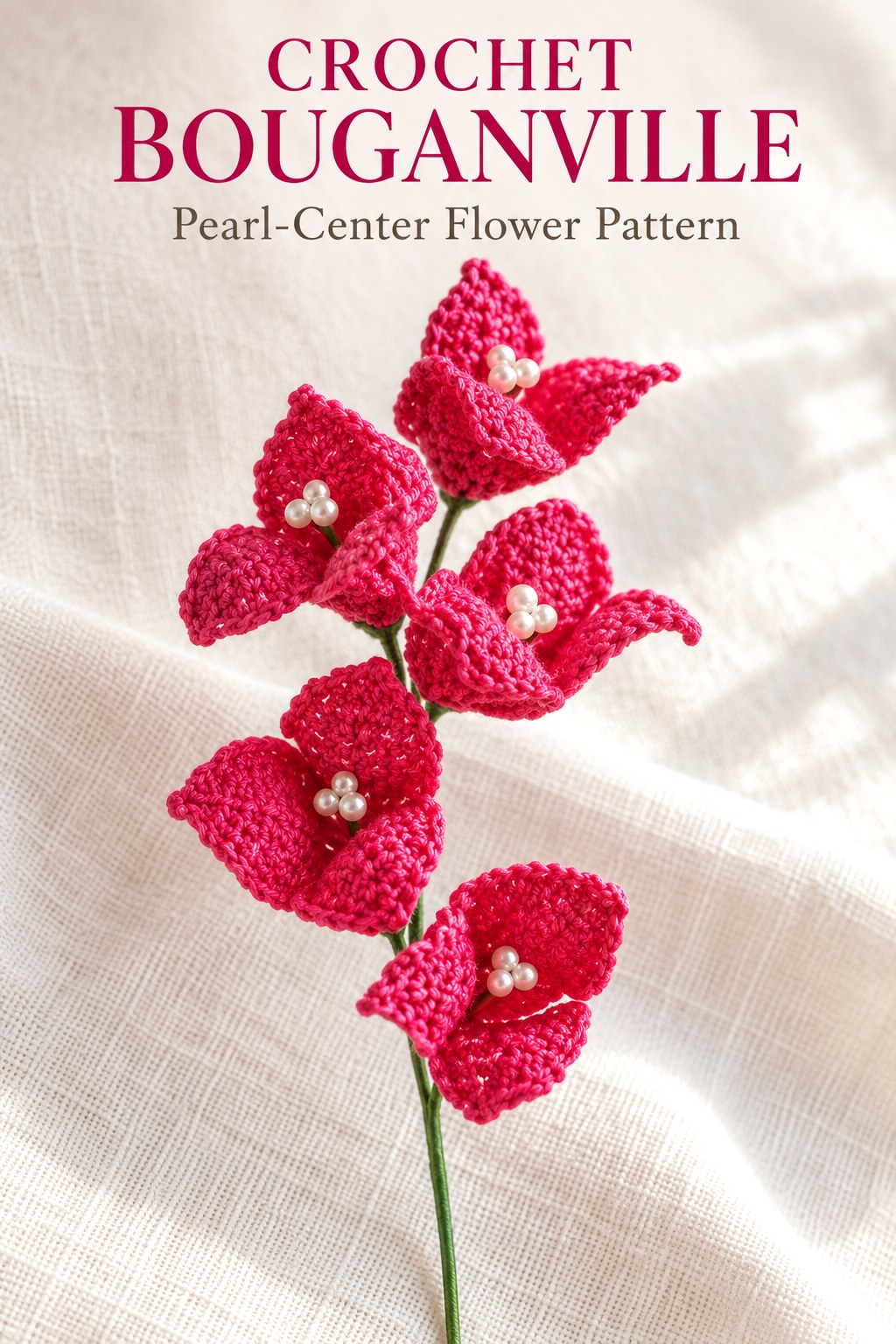
This crochet Bouganville pattern makes dark-pink three-bract flower units with small white pearl centers, joined into a delicate green-wire sprig. It follows the design titled Bouganville on PDF page seventy-six of the supplied collection. The connected bracts are shaped through short rows, joined along their lower edges and fitted with a three-pearl wire pistil. This guide includes the written sequence, actual three-bract chart, source process photographs and relevant symbol legend. The first fifteen-chain foundation and later eight-chain extensions are retained rather than replaced with independently made petals.

Key Takeaways
- Use dark-pink cotton yarn and the specified 1.90 mm hook.
- The flower is one connected three-bract piece, not three separately cut petals.
- Start with fifteen chains and use eight-chain extensions between the bract sections.
- The source’s MD symbol is translated as US treble using the matching two-bar chart symbol.
- Each pistil uses three white pearls on green 0.6 mm wire.
- The listed fifteen pearls provide five three-pearl centers; join the completed units from top to bottom.
CROCHET BOUGANVILLE FLOWER PATTERN
Project: A dark-pink three-bract crochet flower with a white three-pearl center, repeated and joined on green wire to form a sprig.
| Skill level | No difficulty grade is shown for this entry. Uses short rows, slip-stitch joins and wired pearl assembly. |
|---|---|
| Yarn | Dark-pink cotton yarn. Weight, cotton thread number, brand and quantity are not specified in this entry. |
| Hook | 1.90 mm crochet hook. |
| Wire and pearls | Green 0.6 mm wire and 15 white pearls. Each center uses 3 pearls, providing material for 5 flower units. Pearl size and wire-cut lengths are not supplied. |
| Gauge and size | Gauge, finished flower width and sprig dimensions are not stated. |
| US abbreviations | ch = chain; sc = single crochet; dc = double crochet; tr = treble crochet, corresponding to source MD and its two-bar symbol; ss = source ST, slip stitch. |
| Foundation | Ch15. |
| Bract row 1 | Ch1; 2 sc, 2 dc, 7 tr, 2 dc, 2 sc. |
| Bract row 2 | Ch1; 2 sc, 2 dc, 7 tr, dc, sc, ss. |
| Bract row 3 | Ch1, skip 1 stitch, work 5 ss. Add 8 chains when continuing into the next bract section. |
| Three-bract repeat | Work the row 1–3 sequence for 3 bracts in total, using the added eight-chain sections to continue the connected piece. Follow the actual chart for the shared lower edge; do not begin a fourth bract. |
| Lower join and fastening | Join the edges with 7 ss. Fasten with 2 chains as printed and cut the yarn. |
| Pearl pistil | Put 3 white pearls on a green wire length and twist the wire below them. |
| Join pistil to flower | Insert the pearl pistil into the flower and twist the supporting wire to secure it. |
| Sprig assembly | Join completed flower units by twisting their wires together, working from the top toward the bottom. The source does not add a separate crochet leaf or taped holder. |
Understand Three Bracts as One Connected Piece
The source chart shows three pointed bracts joined around one center. They are developed in a connected sequence, using a fifteen-chain beginning and later eight-chain extensions. The finished unit is then closed with seven slip stitches along its lower edges before the pearl center is inserted.
Keep that connected construction distinct from a method that crochets three complete loose petals and sews them together afterward. No instruction cuts the yarn between the three bract sections. The seven-slip-stitch join completes the lower shape while leaving an opening for the wire pistil.
Read the Written Cotton and Wire Materials
The local material list specifies dark-pink cotton yarn, a 1.90 mm hook, green wire 0.6 millimeters in diameter and fifteen white pearls. It does not specify cotton thread number, yardage, pearl diameter or the cut length of each wire. Keep those omissions clear when selecting actual supplies.
The source image shows the white centers as small three-pearl clusters. Choose pearls whose holes work with your actual listed wire, identifying their size as a practical selection rather than a printed measurement. The green wire remains the support; no separate rod, glue, filling or floral-tape material appears in this entry’s list.
No gauge or finished flower dimension is supplied. The photographs cannot establish a precise bract width without a stated scale. Assess the resulting connected flower in your own cotton and tension rather than promising a fixed miniature size from the hook measurement alone.
Material checkpoint: The local pattern lists dark-pink cotton, a 1.90 mm hook, green 0.6 mm wire and white pearls. It does not add a rod, stuffing or a crochet leaf.
Translate MD and ST with the Chart
The written rows use MD for the tall middle stitches. The chart shows the two-bar tall-stitch symbol that the general legend labels triple crochet. This guide uses the usual US name treble crochet, written tr, so readers can work the same symbol without interpreting MD as a shorter US double.
ST in this chapter means slip stitch, as the general legend states. It is used for the partial return, lower join and closing movements. Keep that abbreviation distinct from the generic English use of st for any stitch. The pattern card writes ss for the actual slip stitches.

Begin with the Fifteen-Chain Foundation
Chain fifteen. The first shaped row begins with chain one, then two singles, two doubles, seven trebles, two doubles and two singles. These fifteen working stitches rise toward the middle and lower again toward the other end, establishing a pointed bract profile through stitch height.
Keep the initial chain-one height allowance separate from the named stitch runs. The center seven are trebles, not seven double crochets. Working the shorter stitch would change the bract depth relative to the chart and the curved three-bract finished form.
Work the Shorter Second Row
Chain one for the second row. Work two singles, two doubles, seven trebles, one double, one single and one slip stitch. The returning row ends earlier in its shaped sequence than the first, preserving the partial-row construction shown in the chart.
Do not add an unlisted single crochet simply to make the written line contain fifteen ordinary stitches. Its final slip stitch is part of the shaping. Keep the lower shared portion of the connected piece identifiable before the next row’s short slip-stitch return and chain extension.
Use Row Three and the Eight-Chain Extension
Chain one, skip one stitch and work five slip stitches for the third row. Add eight chains to continue into the next bract section. The new short-chain extension and retained part of the worked piece combine in the connected construction rather than starting an entirely independent fifteen-chain petal.
Repeat the same shaped row sequence for three bracts in total, following the source chart’s shared lower edge. The chart shows three bracts, so the transition chains develop the remaining sections and do not create a fourth flower lobe after the third is complete.
Connected-Bract Note
The first bract starts with fifteen chains. Later bracts are developed through eight-chain extensions and partial returns within the same piece. The chart shows the shared base and the final three-bract arrangement.
Keep the Three-Section Repeat Tally Clear
Count one complete shaped bract section before beginning the next, retaining the same three written row operations. The source’s repeat statement and chart together establish three total bracts. Count the actual pointed sections rather than every short chain extension as a separate petal.
The curved lines below the chart illustrate the relationship between the connected sections and their eventual joining. They do not instruct additional circles of crochet or extra overlapping bracts. Use the actual stitch symbols and starting and ending markers to track the working path.
Join the Lower Edges with Seven Slip Stitches
Once the three-bract piece is formed, join its edges with seven slip stitches. This closes the shared lower portion around the center while preserving the three larger cupped bract surfaces. The source then fastens with two chains and cuts the yarn.
Keep the join at the lower edges shown by the chart rather than stitching all three pointed tips together. There is no separate numbered sewing seam or adhesive instruction. The slipped join is part of the crochet construction and precedes the wire pistil assembly.
