


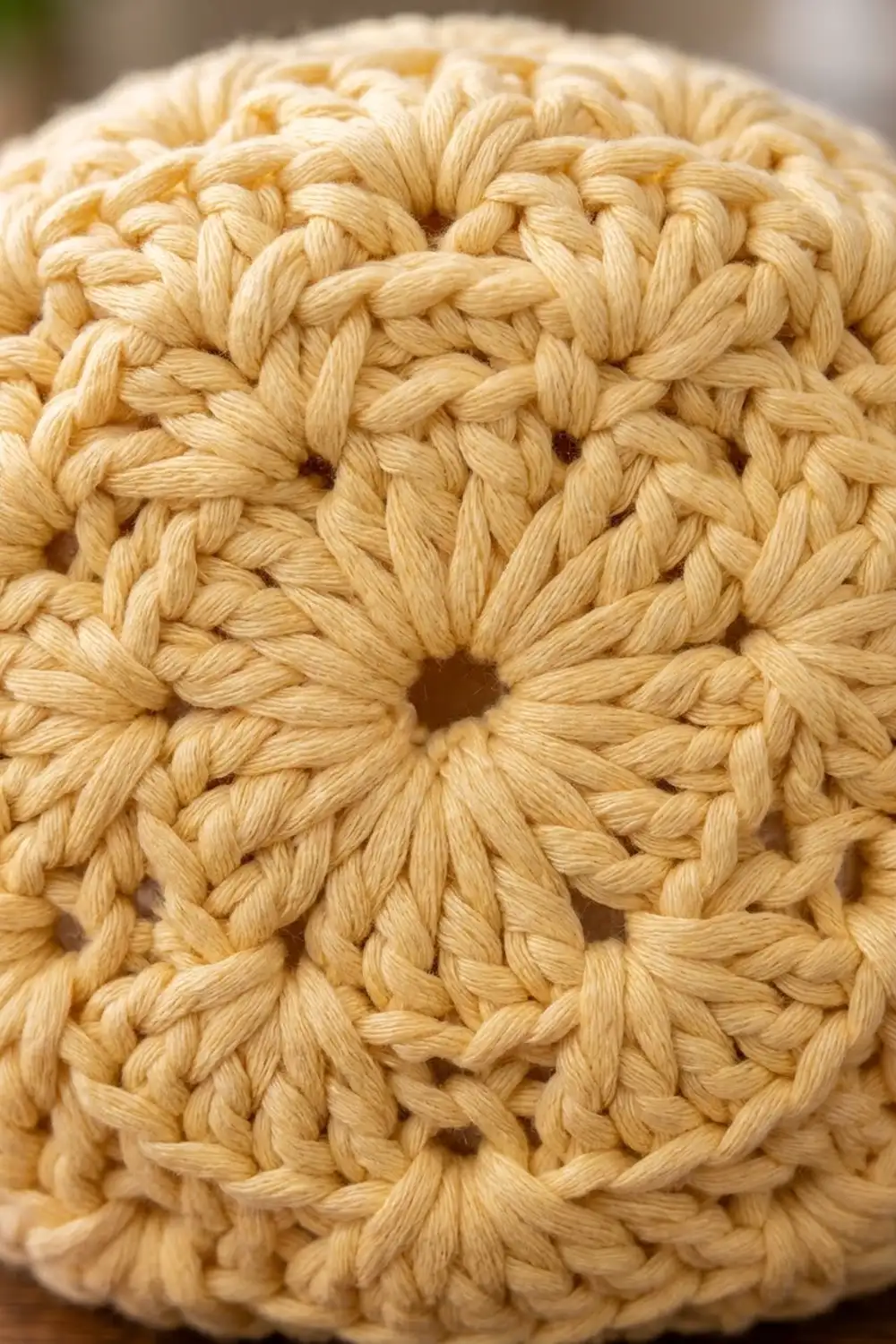
The Buttercup Shell Plastic Bag Holder hangs up to store plastic bags and has a soft, sculpted look. Staggered shell fans cover the whole cylinder, and a firm single crochet rim finishes the top. A thick crocheted ring at the back lets it hang from a door knob or cabinet hook.
It is worked in one solid color, a warm butter yellow, in bulky cotton-blend yarn. The chunky texture hides the bags well, and the rounded base keeps the holder tidy even when it is full.
This pattern uses US crochet terms. The finished body measures about 6.9 in (17.5 cm) across and 8.3 in (21.1 cm) tall. With the ring attached, the full piece is about 11.6 in (29.5 cm) tall.
Construction is simple. You start at the bottom around a small opening and work a flat base outward in single crochet. Then you turn the edge upward and work eight rounds of shells, and three rim rounds close the top. Last, you cover a ring with single crochet and sew it inside the back wall. Bags go in the top and come out one at a time through the bottom opening.
Finished Size and Construction
- Finished size: body 6.9 in (17.5 cm) in diameter x 8.3 in (21.1 cm) tall; 11.6 in (29.5 cm) tall including the ring
- Circumference: 21.8 in (55.4 cm)
- Skill level: Easy-intermediate
- Terminology: US
- Yarn weight: Bulky (#5)
- Hook: 6 mm (US J-10)
- Number of pieces: 2 (body and hanging ring)
- Layout: Ring centered at the back of the rim, rising above the top opening
- Piece size: Body 6.9 in (17.5 cm) x 8.3 in (21.1 cm); ring 4.5 in (11.4 cm) outer diameter
- Size before border: 6.9 in (17.5 cm) in diameter x 7.3 in (18.5 cm) tall
- Border depth: 1 in (2.5 cm), worked as the top rim
Materials
Choose a smooth bulky cotton or cotton-acrylic blend with good stitch definition. Pure acrylic also works, but cotton holds the cylinder shape better. Avoid fuzzy or brushed yarns, because they blur the shells.
- Butter yellow: 220 g, about 310 m (339 yd), based on a yarn of roughly 140 m (153 yd) per 100 g. The body uses about 165 g and the ring about 20 g.
These quantities include a margin of about 35 g for swatching and differences in gauge.
Tools:
- 6 mm (US J-10) hook
- One 3.5 in (8.9 cm) metal, wooden, or plastic ring
- Tapestry needle
- 2 stitch markers
- Scissors
- Measuring tape
- Spray bottle and a small towel for blocking
Abbreviations (US Terms)
- ch – chain
- sl st – slip stitch
- sc – single crochet
- hdc – half double crochet
- dc – double crochet
- sk – skip
- st(s) – stitch(es)
- rnd – round
- rep – repeat
Special stitch – Shell: 5 dc in the same stitch.
Split shell: In Round B, you work ch 3 (counts as 1 dc) and 2 dc into the first stitch at the start of the round. At the end of the round, you work 2 more dc into that same stitch. Together they make one full shell of 5 sts.
Gauge and Checkpoints
Gauge: 11 sc and 12 sc rounds = 4 in (10.2 cm). In shell pattern, one 6-st repeat = 2.2 in (5.6 cm), and 4 shell rounds = 3.5 in (8.9 cm).
Use the base as your test piece. Work Rnds 1–9 before you commit to the whole holder, then measure.
- After Rnd 5 (36 sts): base diameter about 4.2 in (10.7 cm)
- After Rnd 9 (60 sts): base diameter 6.9 in (17.5 cm), lying flat
- After Rnd 14: side height about 3.8 in (9.7 cm), measured from the base edge
- After Rnd 18: side height about 7.3 in (18.5 cm)
- After Rnd 21: side height 8.3 in (21.1 cm)
If your base is larger than 6.9 in (17.5 cm), go down to a 5.5 mm (US I-9) hook. If it is smaller, go up to a 6.5 mm (US K-10.5) hook. Don’t change the stitch counts, because the shell repeat depends on exactly 60 sts.
Body
The body is worked in joined rounds with the right side facing you. Place a marker in the first stitch of each round. Keep the round joins lined up, because this line becomes the back of the holder.
Base
Foundation: Ch 12, then sl st in the first ch to form a ring. Don’t twist the chain. This ring becomes the bag opening, about 1.4 in (3.6 cm) across.
Rnd 1: Ch 1, sc in each ch around, sl st to first sc. (12 sts)
Rnd 2: Ch 1, *sc in next st, 2 sc in next st; rep from * around, sl st to first sc. (18 sts)
Rnd 3: Ch 1, *sc in next 2 sts, 2 sc in next st; rep from * around, sl st to first sc. (24 sts)
Rnd 4: Ch 1, *sc in next 3 sts, 2 sc in next st; rep from * around, sl st to first sc. (30 sts)
Rnd 5: Ch 1, *sc in next 4 sts, 2 sc in next st; rep from * around, sl st to first sc. (36 sts)
Rnd 6: Ch 1, *sc in next 5 sts, 2 sc in next st; rep from * around, sl st to first sc. (42 sts)
Rnd 7: Ch 1, *sc in next 6 sts, 2 sc in next st; rep from * around, sl st to first sc. (48 sts)
Rnd 8: Ch 1, *sc in next 7 sts, 2 sc in next st; rep from * around, sl st to first sc. (54 sts)
Rnd 9: Ch 1, *sc in next 8 sts, 2 sc in next st; rep from * around, sl st to first sc. (60 sts)
Checkpoint: the base should lie flat and measure 6.9 in (17.5 cm) across.
Rnd 10: Ch 1, sc in each st around, sl st to first sc. (60 sts)
This round has no increases, so the edge starts to curve upward. That gives a soft, rounded bottom edge instead of a sharp corner. This round adds about 1/3 in (0.8 cm) of height.
Shell Sides
The sides alternate between two rounds, A and B. Each new shell sits on the single crochet between two shells of the round below, so the fans stagger like brickwork.
Rnd 11 (Round A): Ch 1, sc in first st, sk 2 sts, 5 dc in next st, sk 2 sts, *sc in next st, sk 2 sts, 5 dc in next st, sk 2 sts; rep from * 8 more times, sl st to first sc. (10 shells + 10 sc = 60 sts)
Rnd 12 (Round B):Ch 3 (counts as dc), 2 dc in same st as join, sk 2 dc, sc in next dc (center dc of shell), *sk 2 dc, 5 dc in next sc, sk 2 dc, sc in next dc (center dc of shell); rep from * 8 more times, sk 2 dc, 2 dc in same st as beginning ch-3, sl st to top of ch-3. (3 + 1 + + 2 = 60 sts: 10 shells including the split shell, plus 10 sc)
Rnd 13 (Round A): Ch 1, sc in same st as join (center of the split shell), *sk 2 dc, 5 dc in next sc, sk 2 dc, sc in next dc (center dc of shell); rep from * 8 more times, sk 2 dc, 5 dc in next sc, sk 2 dc, sl st to first sc. (10 shells + 10 sc = 60 sts)
Rnd 14: Rep Rnd 12. (60 sts)
Checkpoint: the side height should be about 3.8 in (9.7 cm).
