

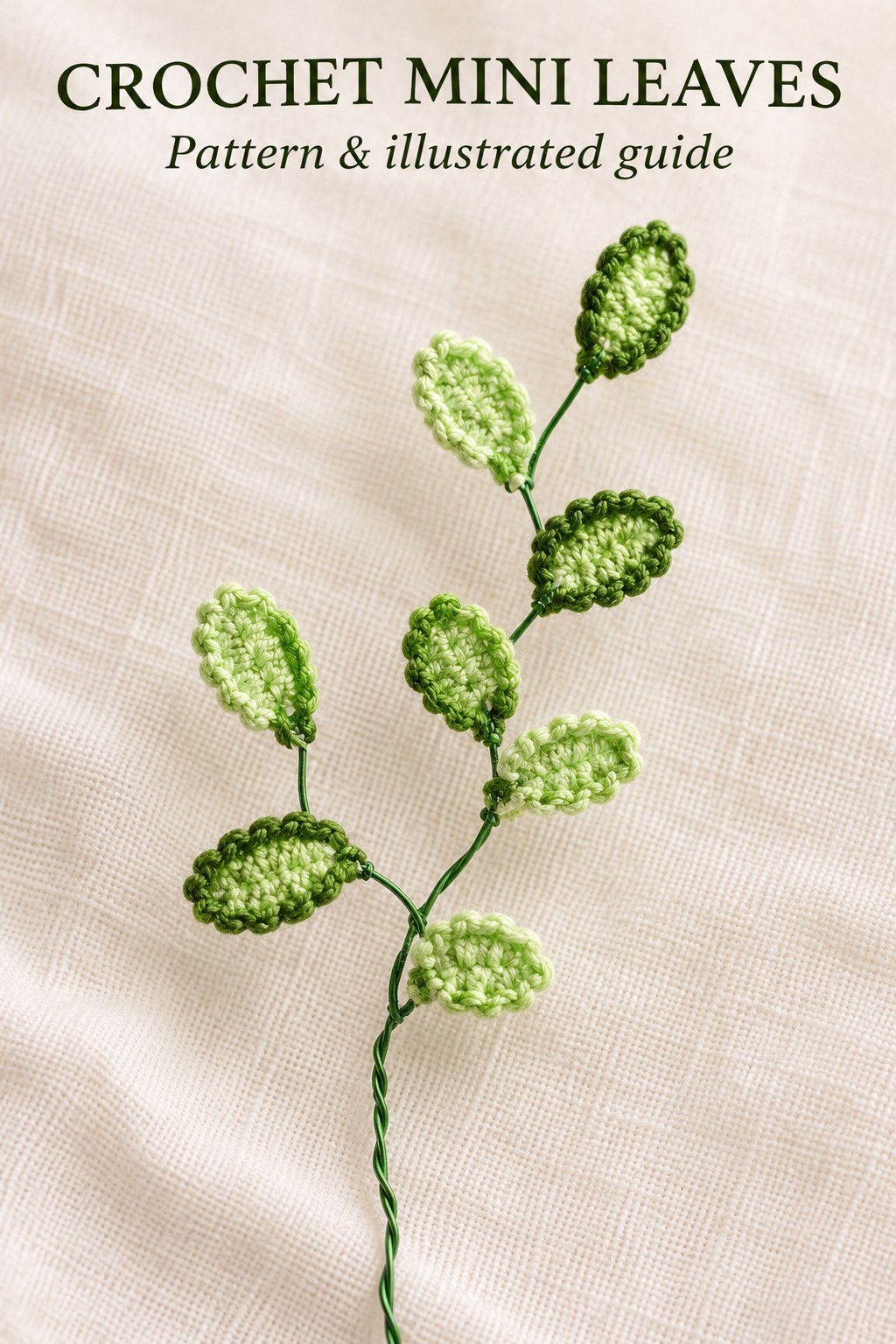
This crochet Mini Leaves pattern makes small cotton leaf components with a simple shaped foundation and a choice of two border finishes. Eight or more leaves are attached to green wire to create the delicate branch shown in the source photograph. The design appears on PDF page 149 of the supplied collection. This guide preserves the complete leaf sequence, the optional crab-stitch or single-crochet border and the actual wiring method, with the original chart and source process photographs alongside the relevant steps.

Key Takeaways
- Use green and soft-green cotton with a 1.90 mm hook.
- The source specifies green 0.8 mm wire for the branch support.
- Each leaf starts with six working chains plus one height chain.
- The shaped first section is one single, four doubles and one single.
- Work around the leaf in either crab stitch or ordinary single crochet, then join and finish.
- Make eight or more leaves, pass wire through their backs and lock each one at its base.
CROCHET MINI LEAVES PATTERN
Project: Tiny cotton leaves in two greens, with a choice of textured or plain edging, assembled into a supported wire branch.
| Skill level | No difficulty rating is printed. Uses a short shaped chain foundation, a surrounding border and wire-supported assembly. |
|---|---|
| Materials | Cotton yarn in green and soft green; 1.90 mm hook; green 0.8 mm wire. Yarn weight, quantities and wire-cut lengths are not stated. |
| Gauge and dimensions | No gauge, leaf measurements, branch length or measured spacing is supplied. |
| US abbreviations | ch = chain; sc = single crochet; dc = double crochet; ss = slip stitch, source ST. Crab stitch is reverse single crochet worked in the opposite direction from ordinary sc. |
| Leaf count | Make 8 or more leaves, preserving the same component instructions for each. |
| Leaf foundation | Ch6 plus 1 height chain. |
| Leaf first section, source round 1 | Sc, 4 dc, sc. 6 worked stitches along the foundation, following the one-sided path shown in the chart. |
| Leaf border, source round 2 | Work around the leaf in crab stitch or sc. Ss to join. Ch2 to lock, cut the yarn and tie the knot. The source does not provide a numerical border count. |
| First leaf support | On the back of the first leaf, insert wire from base to top. Bend the wire and lock it at the base. |
| Continue the branch | Insert the next leaves and lock the wire at their bases. Follow the actual source assembly photographs; no fixed placement angles or measured spacing are stated. |
| Color distribution | The palette is green and soft green. The source photograph shows contrasting centers and rims, but the written instructions do not prescribe a numbered color-change sequence. |
Understand the Small Leaf Component
The foundation has six working positions. A single crochet at either end frames four doubles in the middle, giving the small component a fuller center and shorter ends. The surrounding border then finishes the outline before wire is added at the back. Each leaf remains a separate piece until assembly.
The source chart shows the first stitch sequence along one side of the foundation, not a doubled sequence around both sides. Keep that local construction clear when moving from other leaf patterns in the collection. This miniature entry does not ask for a second four-double run along the opposite foundation side.
Prepare Green Cotton and the Listed Hook
The materials are cotton yarn in green and soft green, a 1.90 mm crochet hook and green 0.8 mm wire. Set aside both shades so you can follow the contrast visible in the completed branch. The cotton stitches form the small leaf faces and rims, while the wire supplies their branch support.
No formal yarn weight, thread number, brand or quantity is printed. Select workable cotton within that description and assess your own fabric. The hook size alone does not establish a guaranteed finished leaf measurement. Keep any allowance chosen for your own materials separate from the source specifications rather than adding an invented amount to the pattern table.
Leaf count: The source calls for eight or more separate leaves. Prepare complete components before judging the finished branch, rather than counting border loops or wire offshoots as additional leaves.
Count Six Working Chains and One Height Chain
Begin each leaf with six chains plus one height chain. The six form the working foundation for the six stitches in the first section. The extra chain provides the starting allowance and should not become an accidental seventh working position. Count the short foundation before beginning the shaped stitches.
Keep the chain identifiable while working such a small piece. A twisted or skipped chain can make a short component appear nearly correct even when its count is wrong. Correct the foundation or first section while it is still accessible, rather than relying on the later border or support wire to conceal a missing stitch.
Work the Single, Four Doubles and Final Single
Work one single crochet, four double crochets and one final single along the foundation as charted. This produces six completed stitches: one plus four plus one. The doubles occupy four successive positions, not one shared original, because no increase instruction is given for this section.
The shorter end stitches and taller middle stitches create the simple leaf face. Do not replace the four doubles with four trebles from a larger leaf design or close them together as a cluster. Each double is a complete independent stitch with its own finished top, and the six-position count remains unchanged.

Keep the First Section Distinct from the Border
The source labels the shaped foundation section round one and the surrounding finish round two. Its diagram shows their different routes clearly. Finish the six-stitch shaped section before traveling around the component’s perimeter. The border is not another straight six-stitch row worked back across the same tops only.
The actual instruction allows two border methods around the same leaf. Neither choice changes the foundation count or adds a separate second leaf face. Keep the first-section six-stitch check beside the broader perimeter task so an unspecified border total is not mistaken for missing first-section stitches.
Choose Crab Stitch for a Textured Rim
Crab stitch is the standard reverse single crochet finish. It is worked in the opposite direction from ordinary single crochet, creating a small corded texture around the edge. The source permits this choice for the full surrounding border, giving the tiny leaf a more visibly textured rim.
Insert into the next edge position in that reverse direction, draw up a loop and complete the single-crochet action. Continue around the existing outline. This explanation describes the named stitch, not a new stitch-count formula: the source does not supply a numerical border count or require a particular number of repeats at every corner.
Choose Ordinary Single Crochet for the Other Source Option
The second permitted border is ordinary single crochet worked around the leaf. This gives a simpler finish using the same component and preparation. Follow the perimeter shown by the chart, surrounding the shaped first section rather than adding an unrelated decorative fan or a new long foundation extension.
Both options belong to the source. Choose the finish you intend before completing a matching set so the branch has a consistent edge character, unless you deliberately want a mixed personal variation. The source does not assign one border type to green yarn and the other to soft green, so do not invent that relationship.
Border Construction Note
Crab stitch and single crochet are alternatives for the same surrounding finish. The six-stitch leaf face stays unchanged. The source does not give a border total, so retain the actual perimeter route rather than borrowing a numerical count from a different leaf.
Join, Lock and Finish Each Leaf
After working the chosen border, join with a slip stitch. Chain two to lock, cut the yarn and tie the knot as directed. Keep the finished rim separate from the starting foundation chain so the small component retains its shape and the finishing treatment does not create an extra unlisted stem.
Assess the leaf before making the remaining set. Check the four central doubles, the single at each end and the continuous chosen border. The source gives no blocking method, stiffening recipe or glued backing. Complete the crochet and its knot before moving to the independent wire-support step shown in the process photographs.
Border checkpoint: No numerical edge total is printed. Keep the surrounding path complete and the named border method consistent; do not invent extra rounds to force a count from another design.
