

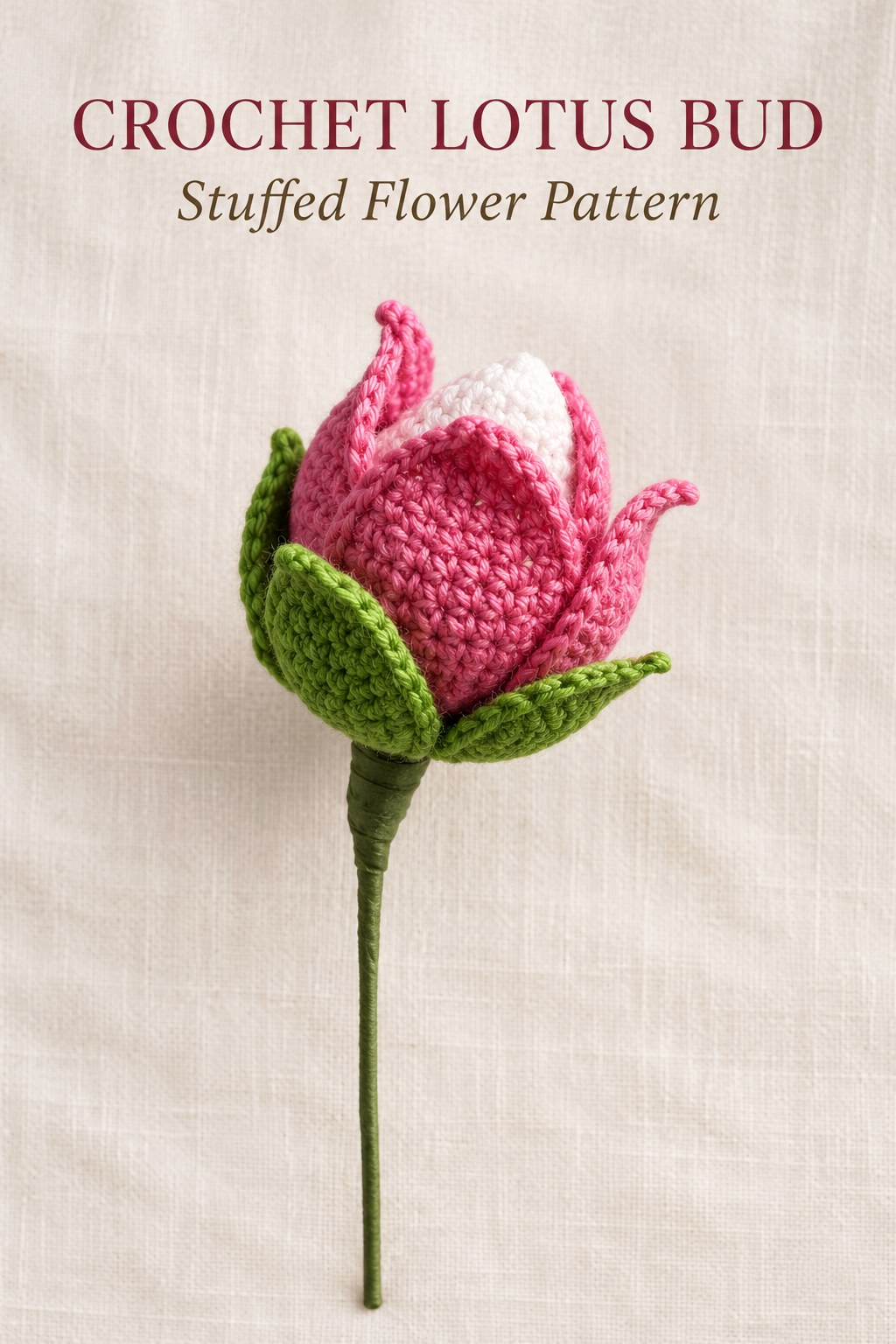
This crochet Lotus Bud pattern encloses a stuffed white core within two connected petal sets: four larger pink Petals A and four smaller green Petals B. It follows PDF pages eighty-five through eighty-seven of the supplied collection. The rounded core is shaped through thirteen rounds, while each petal begins with a short foundation chain and receives an added stem. The two sets are joined separately before nesting around the core. This guide preserves every component sequence and includes the source charts and actual assembly photographs.

Key Takeaways
- Use white, pink and green cotton with a 1.90 mm hook.
- The source lists 0.8 mm wire, stuffing and green floral tape.
- Make one thirteen-round core, four Petals A and four Petals B.
- In this chapter, two stitches together means two complete stitches in the same original, not a decrease.
- Stuff the core after its three twenty-single-crochet rounds, before the last narrowing section.
- Insert the supported core in Petals A, secure them, add Petals B and tape the stem.
CROCHET LOTUS BUD FLOWER PATTERN
Project: A compact stuffed-core bud with four connected pink inner petals, four connected green outer petals and a taped wire stem.
| Skill level | No individual rating is stated. Uses joined rounds, increases, skipped-position shaping, separate petal sets and supported assembly. |
|---|---|
| Materials | Cotton in white, pink and green; 1.90 mm hook; wire 0.8 mm; stuffing; green floral tape. Yarn weight, quantity, gauge, finished size and wire cut length are unspecified. |
| US abbreviations | ch chain; sc single crochet; hdc half double crochet; dc double crochet; ss slip stitch. Source ST means ss. inc-hdc/inc-dc mean 2 full stitches in one original; skip means leave that original unworked. |
| Base round 1 | Magic ring: ch3, 10 dc. Tighten and ss join. |
| Base round 2 | Inc-dc in each original: 20 dc. Ss join. |
| Base round 3 | 10 times: 30 dc. Ss join. |
| Base rounds 4–5 | 30 dc each round for 2 rounds. The source total60 means 60 worked across both rounds, not 60 in one round. |
| Base round 6 | 10 times: 20 sc. |
| Base rounds 7–9 | 20 sc each round for 3 rounds. Add stuffing after this section. |
| Base round 10 | 5 times: 15 sc. |
| Base round 11 | 15 sc. |
| Base round 12 | 5 times: 10 sc. |
| Base round 13 | 5 times: 5 sc. Tighten with ss, lock ch2, cut and hide yarn end inside. |
| Petal A, make 4 | Begin ch15+1. R1: 3 sc, 3 hdc, 3 dc, 3 hdc, 6 sc, 3 hdc, 3 dc, 3 hdc, 3 sc, around both sides of the chain. |
| Petal A round 2 | 3 sc, 3 hdc, inc-hdc 3 times, 3 hdc, 6 sc, 3 hdc, inc-hdc 3 times, 3 hdc, 3 sc. 36 stitches. |
| Petal A round 3 | Begin ch6+1 and work 6 sc for the stem. Continue with 36 sc and 6 ss. Cut yarn. |
| Petal A joining round 4 | Skip18, join yarn and work 6 ss. Ch1+1 and work sc, then 6 ss. Join the next Petal A and repeat the charted joining path through all 4. |
| Petal B, make 4 | Begin ch10+1. R1: 2 sc, 2 hdc, 2 dc, 2 hdc, 4 sc, 2 hdc, 2 dc, 2 hdc, 2 sc, around both sides of the chain. |
| Petal B round 2 | 2 sc, 2 hdc, inc-hdc twice, 2 hdc, 4 sc, 2 hdc, inc-hdc twice, 2 hdc, 2 sc. 24 stitches. |
| Petal B round 3 | Begin ch6+1 and work 6 sc. Continue with ss at the petal base. Cut yarn. |
| Petal B joining round 4 | Skip11, join yarn and work 7 ss. Ch1+1 and work sc, then 7 ss. Join the next Petal B and repeat through all 4. |
| Assembly | Insert wire in the bottom of the stuffed base and twist. Insert the base inside joined Petals A; lock their bottom using yarn or wire. Place joined Petals B outside Petals A and secure using yarn or wire. Cover the joined support stem with green floral tape. |
Plan the Core and Two Petal Sets
The source calls the white internal piece Base. It is a stuffed rounded component, not a flat disk beneath the flower. Petals A are the larger pink pieces that surround it. Petals B are shorter green outer pieces, forming the lower layer shown in the finished example.
Make four of each petal type. Join the pink set separately from the green set before nesting the pieces together. The source photographs show those two joining stages and the later assembly, so the eight petals should not be combined into a single alternating pink-and-green ring during crochet.
Materials, Support and Stitch Language
Use the listed white, pink and green cotton yarn with a 1.90 mm hook. The source also specifies stuffing, wire 0.8 mm in diameter and green floral tape. It gives no formal cotton weight, brand, yardage, finished dimensions, gauge or numerical wire-cut length.
The chapter uses US stitch names. ST is slip stitch, and two complete half doubles or doubles together in one original is an increase. This meaning differs from the shared-top decreases often abbreviated hdc2tog or dc2tog elsewhere. The charts and stated component totals confirm the increase interpretation here.
The source narrows the white base with skipped-position groups rather than with those same-anchor increases. Keep that distinction clear. A repeat such as skip one, two singles consumes three originals but produces two stitches, while an increase produces two from one original.
Component checkpoint: Prepare one stuffed base, four pink Petals A and four green Petals B. Their joining paths differ, so keep the sets separate until the photographed nesting stage.
Base Rounds 1–3: Expand Ten to Thirty
Make a magic ring in white, chain three and work ten double crochets. Tighten the ring and join with a slip stitch. Round two puts two full doubles into each original, giving twenty, and joins. Round three repeats a double increase followed by one plain double ten times, giving thirty.
Keep the starting chain separate from the stated working totals. The source’s following rounds use ten, twenty and thirty actual working positions. Do not create an extra eleventh original or reinterpret the first increase round as a decrease, which would prevent the rounded core from forming.
Base Rounds 4–6: Hold Thirty, then Narrow
Work thirty double crochets in each of rounds four and five. The source also prints sixty double crochets beside this two-round section, meaning the combined number worked, not a live circumference of sixty. Keep a separate round tally and thirty-stitch check.
Round six repeats skip one and work two singles ten times. Thirty incoming positions become twenty single crochets. This change also switches stitch height from doubles to singles. Do not add another increase while changing stitch type or carry sixty as the incoming count.

Base Rounds 7–9: Work the Stuffing Section
Work twenty single crochets in each of rounds seven, eight and nine. The source’s sixty-single total again describes three rounds combined. Keep twenty working positions throughout. Add the listed stuffing after this steady body section, as shown in the source photograph.
No stuffing amount or weight is specified. Assess the filling with the actual cotton fabric so it supports the rounded core without forcing through the stitches. The final four narrowing rounds remain to be worked after this stage, so do not close the twenty-stitch opening with a separate drawstring yet.
Base Count Note
The core progresses 10 → 20 → 30, holds thirty for two rounds, narrows to twenty, holds twenty for three rounds, then narrows 15 → 15 → 10 → 5 before fastening.
Base Rounds 10–13: Finish the Stuffed Core
Round ten repeats skip one and three singles five times, reducing twenty to fifteen. Round eleven works fifteen singles. Round twelve repeats skip one and two singles five times, reducing to ten. Round thirteen repeats skip one and one single five times, leaving five.
Tighten the circle with one slip stitch, lock with two chains and cut the yarn. Hide the end inside. The source photograph shows the completed teardrop-like white base before it is inserted among the petals. Its support wire is added during the following assembly stage, not crocheted into these narrowing rounds.
Base checkpoint: Stuff after round nine, then follow the final fifteen-, fifteen-, ten- and five-stitch rounds. The combined totals printed for repeated sections are not enlarged circumferences.
Petal A Foundation and First Round
Begin fifteen plus one chains for a larger petal. Work three singles, three half doubles, three doubles, three half doubles, six singles, three half doubles, three doubles, three half doubles and three singles around the two sides of the original chain.
The combined six-single section spans the far end. The two sides use graduated stitch heights to produce the elongated shape shown by the chart. The first round has thirty worked stitches around fifteen working foundation positions, rather than fifteen stitches on a new turned row.
Petal A Round 2: Reach Thirty-Six
Work three singles, three half doubles, three half-double increases, three half doubles and six singles. Continue with three half doubles, three half-double increases, three half doubles and three singles. Six increases add six to the thirty, reaching thirty-six.
Keep each increase pair in one original and complete its stitches individually. The two groups widen the taller middle of the petal, while the single-crochet sections stay lower. Do not replace this shape with an evenly increased circular motif or use the smaller Petal B’s repeat counts.
