

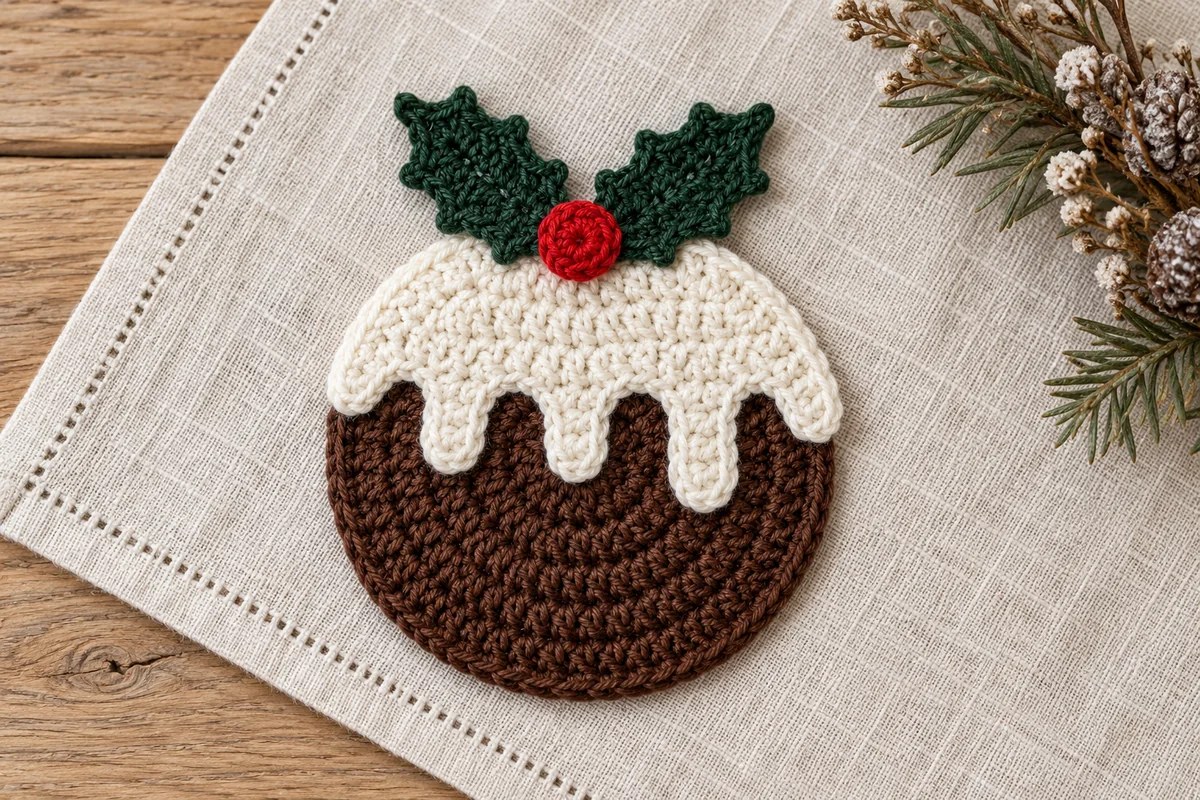
This crochet Christmas pudding turns a brown circle, a little ivory icing, and a sprig of holly into a flat festive applique. The separate icing piece sits over the top of the disk, leaving a rounded brown pudding beneath it.
Use the motif on a fabric gift bag, a handmade card, or a decorative garland. An optional yarn loop lets you hang it as an ornament. Because the icing, leaves, and berry overlap, this design is intended for decoration rather than as a level surface for a cup.
The instructions below are an original interpretation inspired by the reference photograph. They use a joined circular base, a turned semicircle, and four small fans for the icing drips. Finished size and yarn use depend on your yarn, hook, and tension; no measured sample or physical testing is claimed.
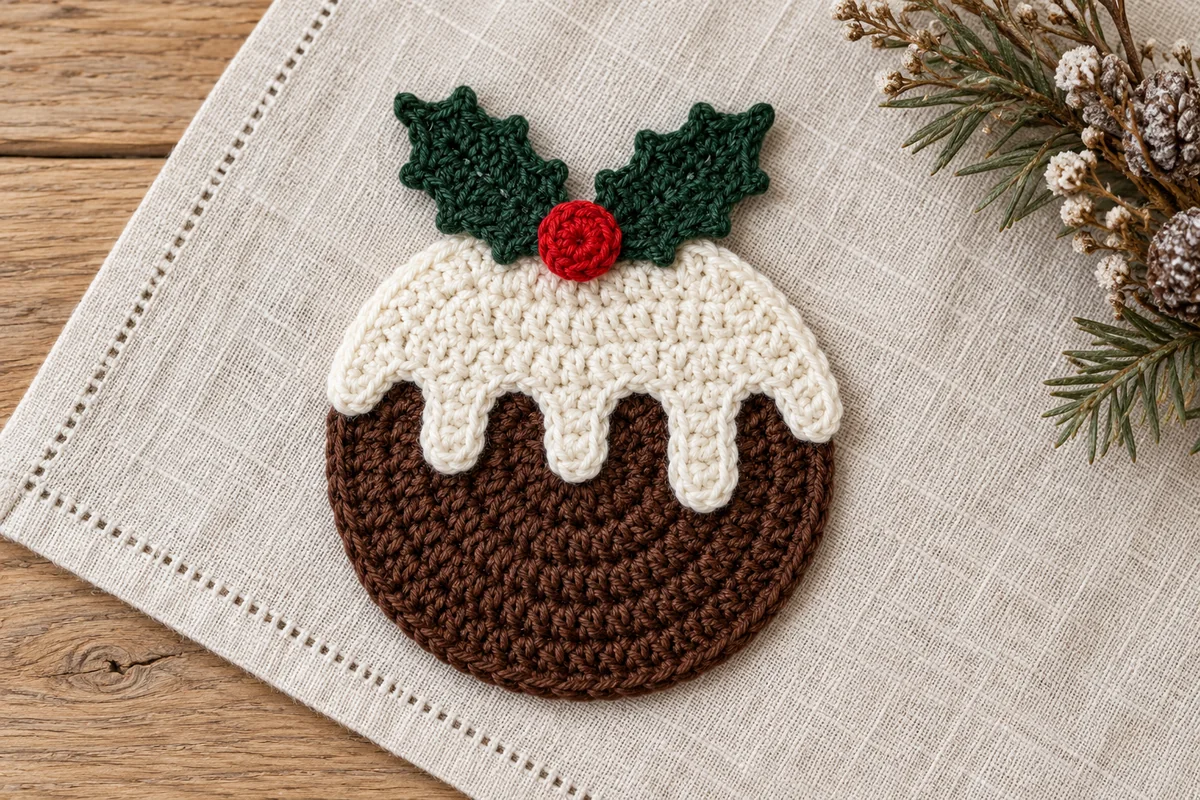
Crochet Christmas Pudding: Construction and Materials
Make the brown disk first and use it to check the curve of the ivory icing before sewing. Both pieces use the same yarn weight and hook. The disk grows by 12 double crochets per round; the semicircle grows by six double crochets per row. A row of single crochet across the straight edge provides the foundation for the drips.
- Smooth yarn in brown, ivory, dark green, and red. Cotton gives clear stitch definition; choose a yarn suitable for the item receiving the applique.
- A hook appropriate for the yarn, plus a smaller hook if your leaf picots are loose.
- Tapestry needle, scissors, removable stitch markers, and pins or clips for positioning the pieces.
- Optional: matching sewing thread for attaching the applique to fabric.
No fixed gauge is required for this decorative motif. Use the same yarn thickness for the brown and ivory pieces so their curves remain comparable. Avoid mixing a bulky icing yarn with a thin base yarn: the upper layer can overwhelm the circle.
US Crochet Abbreviations
- MR = magic ring
- ch = chain
- sl st = slip stitch
- sc = single crochet
- hdc = half double crochet
- dc = double crochet
- inc = 2 stitches of the specified type in one stitch
- st / sts = stitch / stitches
- RS = right side
Brackets show a sequence to repeat. Instructions in parentheses are worked into the same stitch. For standard terminology, see the Craft Yarn Council crochet abbreviation guide.
How to count and turn
All starting chains are excluded from stitch counts. For the brown disk and red berry, join to the first working stitch, not to the starting chain, and do not turn. For icing Rows 1–4, turn only when directed and do not join. Mark the first working stitch if it is difficult to distinguish from the starting chains.
Crochet Christmas Pudding Pattern
1. Brown pudding disk
Round 1: With brown, make an MR, ch 2, work 12 dc into the ring. Pull the ring closed and sl st to the first dc. 12 dc.
Round 2: Ch 2, work 2 dc in every stitch around; sl st to the first dc. 24 dc.
Round 3:Ch 2, 12 times; sl st to the first dc.36 dc.
Round 4:Ch 2, 12 times; sl st to the first dc.48 dc. Fasten off and weave in the ends on the wrong side.
The increases add 12 stitches at every step: 12, 24, 36, 48. Do not add stitches into a joining slip stitch. Lay the disk down before continuing; if it cups or ripples, check the count and relax any unusually tight starting chains.
2. Ivory icing semicircle
Row 1: With ivory, make an MR, ch 2, work 6 dc into the ring. Close the ring, but do not join the row into a circle. Turn. 6 dc.
Row 2: Ch 2, work 2 dc in each st. Turn. 12 dc.
Row 3:Ch 2, 6 times. Turn.18 dc.
Row 4:Ch 2, 6 times.24 dc. Do not fasten off.
Row 5 — straight-edge foundation: Rotate the semicircle so you can work across its straight diameter, starting at the end of Row 4. Ch 1. Work 2 sc into each of the four row ends down to the MR center (8 sc), 1 sc into the center of the MR, then 2 sc into each of the four row ends up the other side (8 sc). 17 sc. Work around the row-end posts rather than splitting a strand. Do not work into the 24 stitches on the curved edge.
The middle stitch of Row 5 is stitch 9. Mark stitches 2, 6, 10, and 14 for the four drips, counting from the end at which you will begin Row 6.
