

This is where the shawl starts to develop its airy, open character. The chain 2 spaces with skipped stitches create windows in the fabric that will really open up when you block the finished piece.
Rows 10 through 20:
Continue the lace repeats with these elements:
Take your time with these rows. The rhythm becomes meditative once you get the hang of it. You are essentially alternating between solid double crochet sections and open chain spaces while maintaining your increases.
Hydrangea Flower Motif Section
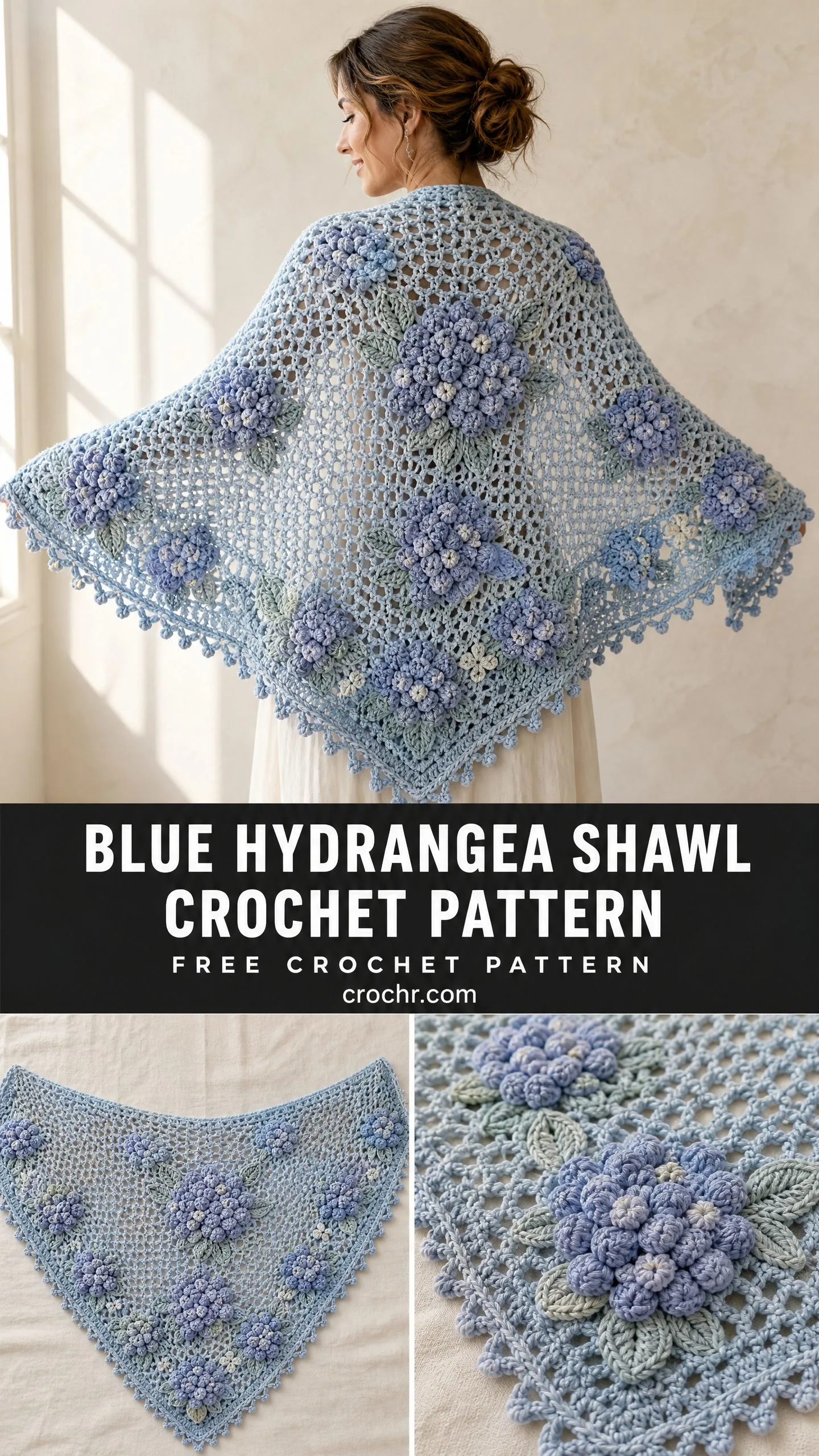
This is the magical part where your shawl transforms from simple lace into something truly special. The flower clusters are worked into selected chain spaces throughout the fabric.
To create each hydrangea cluster:
1. Attach your blue yarn in a lace space.
2. Chain 3, work a 3 double crochet cluster, chain 2, then work a 4 double crochet cluster in the same space.
3. Add small surrounding chain loops to create petal shapes.
4. Repeat floral clusters evenly across the shawl.
A cluster stitch is when you work multiple double crochet stitches that share the same top. You work each double crochet until 2 loops remain on your hook, then yarn over and pull through all loops at once. This creates a gathered, textured effect that mimics the look of hydrangea petals.
Space your flower motifs evenly across the shawl for the most pleasing visual effect. You do not want them too crowded or too sparse. Trust your eye here.
Continue alternating between lace sections and flower motif sections until your shawl reaches the desired depth. The pattern is flexible, so you can add more rows for a larger shawl or stop earlier for something more petite.
Final Border
The border frames your work and gives the shawl a polished, finished appearance.
Round 1:
Work single crochet evenly around the entire shawl edge. This creates a stable foundation for the decorative border that follows.
Round 2:
Create scallops by repeating this sequence around the border:
Skip 2 stitches, work 5 double crochet in the next stitch, skip 2 stitches, slip stitch in next stitch.
The scalloped edge adds a romantic, vintage feel that complements the floral motifs beautifully.
Finishing Your Blue Hydrangea Shawl
Proper finishing makes all the difference with lace projects. Do not skip these steps.
1. Weave in all ends securely. Take your time here. Loose ends can work themselves free over time, especially with a piece that will be worn and washed.
2. Soak the shawl in lukewarm water. Add a little wool wash or gentle soap if you like, but plain water works fine. Let it soak for at least 15 minutes so the fibers fully relax.
3. Block into a triangular shape. Gently squeeze out excess water (never wring), then lay the shawl on your blocking mats.
4. Pin the points and open the lace sections. Use rust-proof pins and be generous. The more pins you use, the more even your finished fabric will be. Stretch the lace open to show off those beautiful chain spaces and flower clusters.
5. Allow to dry completely. This might take 24 hours or more depending on your climate. Patience here pays off enormously.
Care Instructions for Your Finished Shawl
To keep your Blue Hydrangea Shawl looking beautiful for years:
Avoid hanging your shawl, as the weight can stretch the delicate lace over time.
Tips for Success
For the lace sections: Keep your tension consistent but not too tight. Lace needs room to breathe, and overly tight stitches will not block out properly.
For the flower clusters: Practice the cluster stitch on a swatch first if it is new to you. Once you get the rhythm of holding multiple loops on your hook and joining them at the top, it becomes second nature.
For blocking: Do not be shy about stretching. Lace shawls often look small and bunchy before blocking, then transform dramatically. That is completely normal and part of the magic.
If you lose your place: Count your stitches periodically, especially during the increase rows. The center chain 2 space should always be at the exact center of your work.
Wrapping Up
This Blue Hydrangea Shawl crochet pattern creates a truly heirloom quality piece. The combination of delicate lace work and dimensional flower clusters results in something that looks far more complicated than it actually is to make. Once you understand the basic rhythm of increases and lace spacing, the rows flow smoothly.
I hope you love making this as much as I loved designing it. There is something deeply satisfying about watching a simple chain grow into a stunning wearable piece of art.
Thank you so much for choosing this pattern for your next project. I genuinely cannot wait to see your finished shawls. If you make one, please share your photos on Instagram or in my Facebook group. Seeing your work truly makes my day, and it helps other crocheters feel confident tackling new patterns.
If this pattern inspired you, save it to your Pinterest boards so you can find it easily when you are ready to cast on. And please drop a comment below if you make your own Blue Hydrangea Shawl. I would love to hear which colors you chose and how the project went for you. Happy crocheting!
You Might Also Like
- Lavender Garden Toddler Outfit Free Crochet Pattern
- Sunshine Yellow Kitty Tote Bag Free Crochet Pattern
- Neon Glow Snake Plushie Free Crochet Pattern
- Sunflower Table Set Crochet Pattern
CONTENT END 1
