
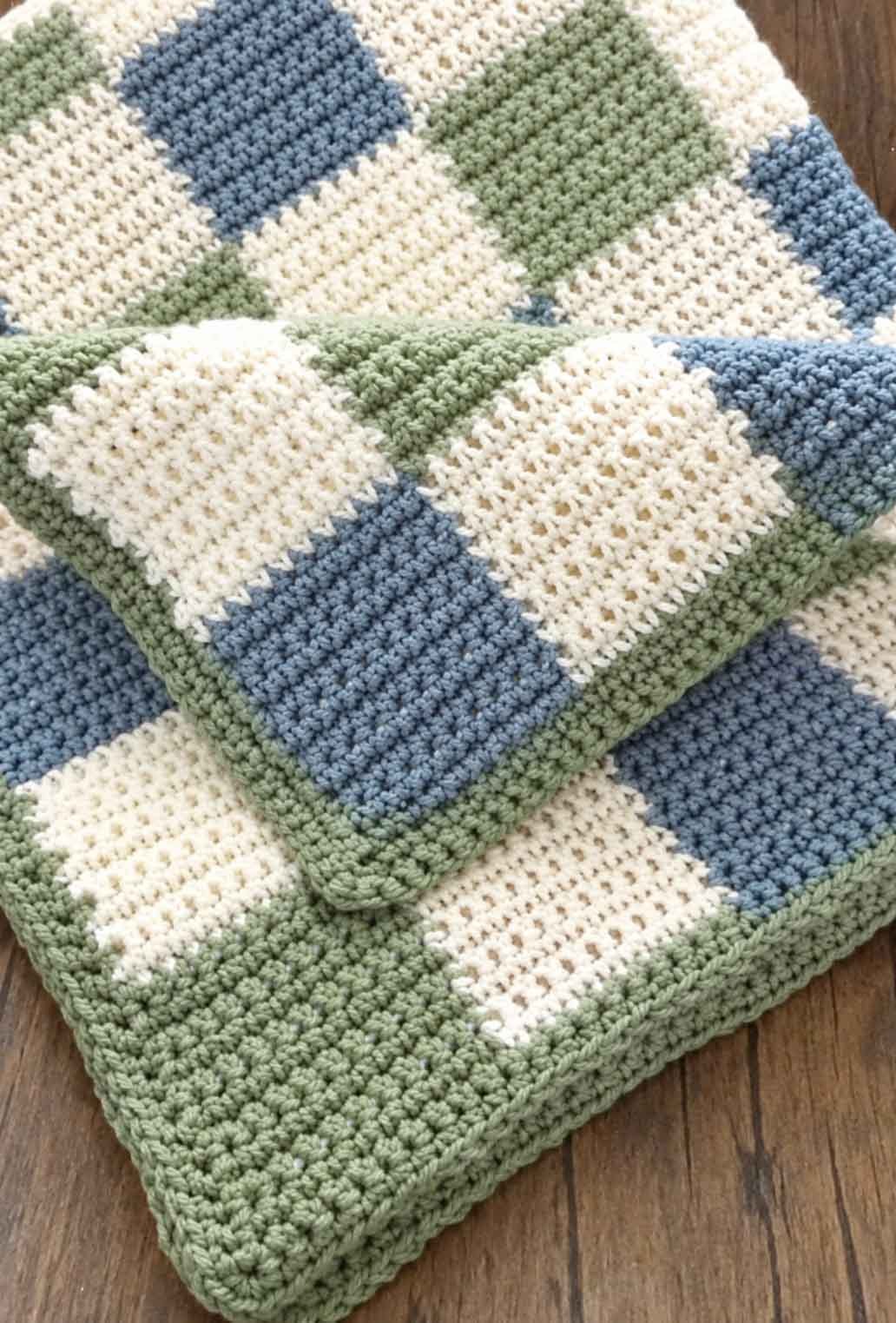
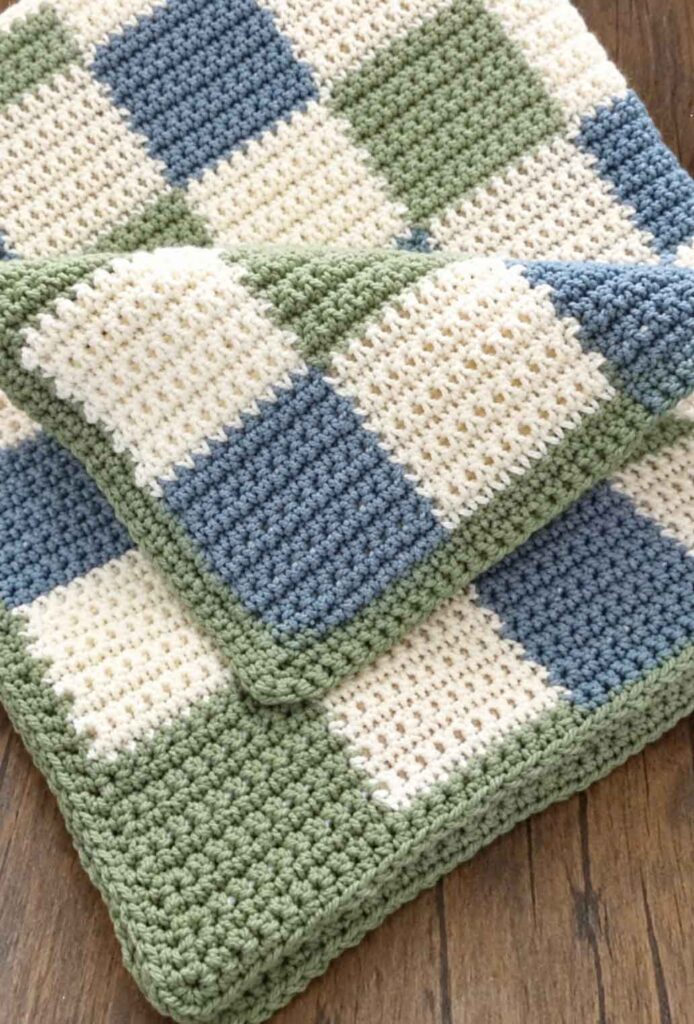
There’s something special about a handmade baby blanket, especially one with a classic pattern that never goes out of style. This Baby Plaid Blanket combines soft colors, simple crochet stitches, and a timeless checked design to create a cozy blanket that would look beautiful in any nursery.
Welcome to Soofha! Today, I’m sharing a crochet project that’s perfect for anyone who loves traditional patterns with a fresh, modern feel. The plaid design might look complicated at first, but it’s made using basic stitches and simple color changes. Once you get into the rhythm, the blocks begin to take shape, and watching the pattern come together is part of the fun.
What I love most about this blanket is how much the colors influence its final look. Blue, cream, and soft green create a peaceful, classic combination, but you could easily switch things up with blush pink, ivory, and beige or try sage green with warmer neutral shades.
The stitch pattern is beginner-friendly, too. You’ll alternate single crochet and double crochet stitches while changing colors every 10 stitches. There’s no complicated stitchwork to learn, so you can focus on creating those neat plaid blocks.
If you’re looking for a handmade baby shower gift or a cozy blanket for your own little one, this pattern is a lovely choice.
ad 26 3
How the Baby Plaid Pattern Works
The plaid effect comes from alternating two different color combinations in sections of 10 rows.
For the first 10 rows, you’ll work with Colors A and B, creating alternating blocks that are each 10 stitches wide. For the next 10 rows, you’ll switch to Colors B and C. Repeating these sections creates the familiar plaid pattern.
The unused yarn is carried along the row and crocheted over as you work. This saves you from cutting the yarn after every color change and leaves fewer ends to weave in when the blanket is finished.
ad 26 3
The pattern uses 130 stitches across and 130 rows from top to bottom. Each block measures 10 stitches wide by 10 rows tall, giving you 13 blocks across and 13 blocks high.
ad 26 3
The finished blanket measures approximately 35 x 40 inches, depending on your yarn, hook, tension, and border.
You can follow the suggested colors or choose your own combination. Just make sure the shades work well together so the plaid design remains easy to see.
Baby Plaid Blanket Details
- Skill level: Beginner to easy
- Project type: Baby blanket
- Construction: Worked back and forth in rows
- Stitch pattern: Alternating single crochet and double crochet
- Colorwork: Three coordinating colors
- Finished size: Approximately 35 x 40 inches
- Hook size: 4.0 mm (US G/6)
Materials You’ll Need
ad 26 3
Gather the following supplies before getting started:
- Light #3 DK-weight baby yarn in three coordinating colors
- Color A: Cotton or cream
- Color B: Dusk Sky or medium blue
- Color C: Jade Frost or soft green
- US G/6 (4.0 mm) crochet hook
- Yarn needle for weaving in ends
- Scissors
For the blue, green, and cream version, Bernat Softee Baby Cotton in Cotton, Dusk Sky, and Jade Frost is one option.
Feel free to use another DK-weight baby yarn you already have. Just remember that changing the yarn or hook size may affect the finished dimensions.
Gauge
The listed gauge is:
16 stitches and 20 rows = 4 inches using a 4.0 mm crochet hook.
For the best results, make your gauge swatch using the actual alternating single crochet and double crochet pattern. This will give you a more accurate idea of how your finished blanket will look and feel.
Crochet Abbreviations
This pattern uses standard US crochet terminology.
- ch: Chain
- sc: Single crochet
- dc: Double crochet
- sl st: Slip stitch
- st(s): Stitch(es)
- BLO: Back loop only
- rnd: Round
Before You Begin
Here are a few helpful things to know before starting the blanket.
- The chain 1 at the beginning of a row does not count as a stitch.
- The blanket body contains 130 stitches per row.
- Each plaid block measures 10 stitches wide and 10 rows tall.
- The completed blanket body contains 130 rows.
- The stitch pattern alternates between single crochet and double crochet.
- Color changes happen every 10 stitches.
- Carry unused yarn along the row rather than cutting it after every block.
A quick note about the stitch pattern: Since single crochet and double crochet stitches have different heights, your rows may look slightly different from a traditional solid-stitch plaid. Keep your tension consistent throughout the project.
How to Change Colors and Carry Yarn
Getting comfortable with color changes is the most important part of this pattern. Once you understand the technique, the rest becomes much easier.
When you reach the end of a 10-stitch color block, begin the final stitch with the current color. For a double crochet, work the stitch until two loops remain on your hook. Then use the new color for the final yarn-over and pull through both loops.
Your new color is now ready to use.
Lay the unused strand along the top of the previous row and crochet over it as you continue working. When you need that color again, simply pick it up and continue.
Try not to pull the carried yarn too tightly. If it’s too tight, the fabric may pucker or become narrower in places. Keeping the strand relaxed will help your blanket stay soft and even.
You may need a little practice at first, but don’t worry. After a few rows, the color changes will start to feel much more natural.
Baby Plaid Blanket Instructions
Foundation Chain
Using Color A, chain 131.
You will work into 130 chains to create the first row.
Rows 1–10: Colors A and B
For the first 10 rows, alternate Colors A and B in blocks of 10 stitches.
Row 1
Starting in the second chain from your hook:
- Work single crochet in the next stitch.
- Work double crochet in the following stitch.
- Continue alternating single crochet and double crochet until you’ve completed 10 stitches in Color A.
- Change to Color B on the final pull-through of the tenth stitch.
- Work the next 10 stitches in Color B, continuing the alternating stitch pattern.
- Change back to Color A after completing the 10-stitch block.
Continue across the row, alternating between 10 stitches in Color A and 10 stitches in Color B.
Because the row contains 130 stitches, you’ll have 13 color blocks. Begin and finish the row with Color A.
Stitch count: 130 stitches
Chain 1 and turn.
Rows 2–10
Continue working the same stitch pattern, alternating single crochet and double crochet across the row.
Keep the color arrangement consistent:
- 10 stitches in Color A
- 10 stitches in Color B
Repeat this sequence across all 130 stitches, carrying the unused yarn inside the stitches.
Start and finish each row with Color A.
At the end of Row 10, you’ll have completed the first section of the plaid pattern.
Rows 11–20: Colors B and C
For the next 10 rows, put Color A aside and work with Colors B and C.
Begin each row with Color B.
- Work the first 10 stitches in Color B.
- Change to Color C and work the next 10 stitches.
- Change back to Color B for the following 10 stitches.
- Continue alternating colors every 10 stitches across the row.
Carry the unused yarn as before, keeping it loose enough to prevent the fabric from bunching.
With 13 blocks across, each row begins and ends with Color B.
Repeat this color arrangement through Row 20.
Stitch count: 130 stitches per row
