

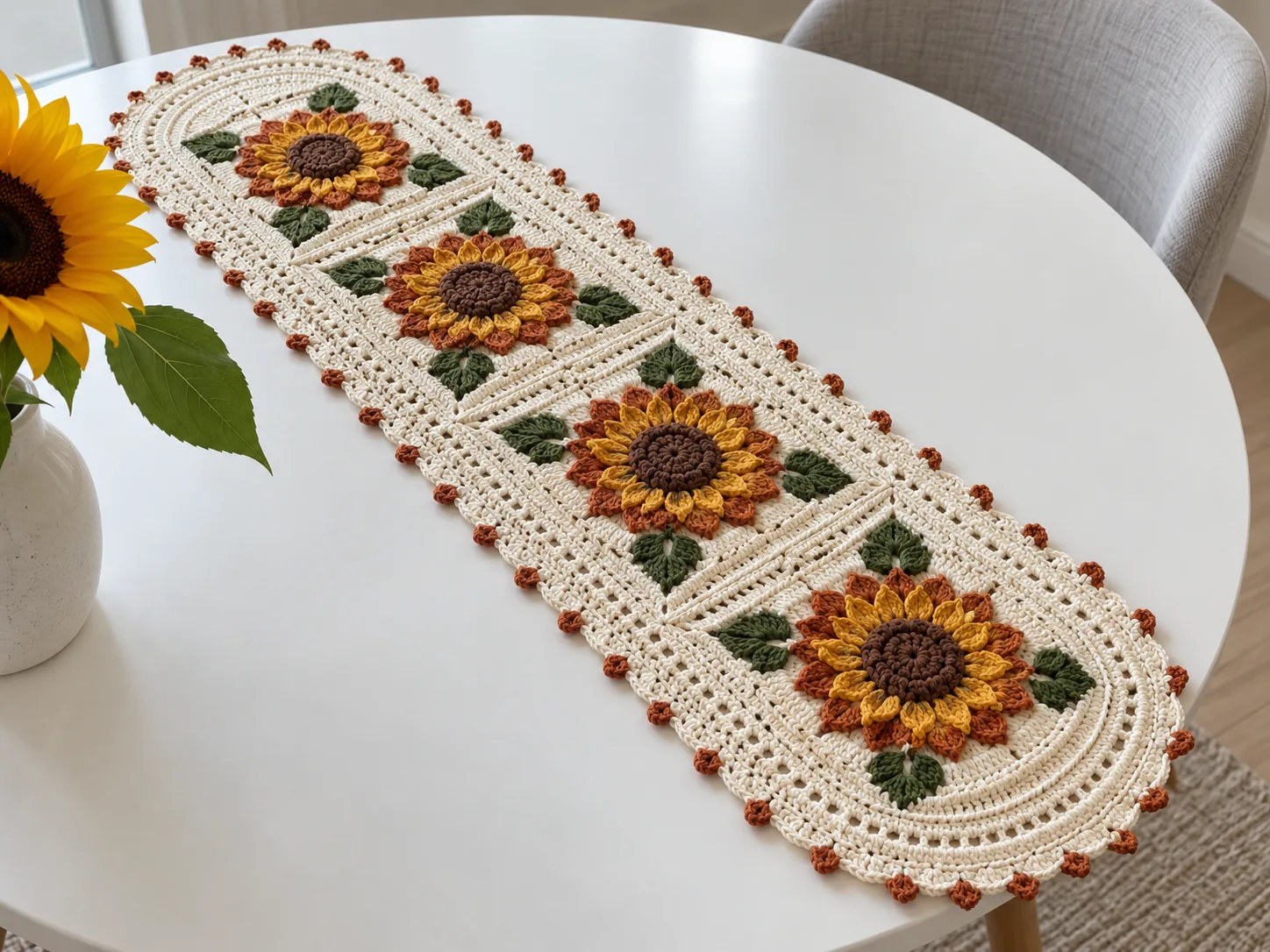
I call this one “Copper Fields” in my pattern notebook, and it has been waiting patiently for its moment since I first sketched it two autumns ago. The original was made for my sister’s farmhouse dining table, where she wanted something that felt handmade and warm but could survive Sunday dinners with her kids. She specifically asked for sunflowers, and I remember spending an entire afternoon swatching different petal techniques until I landed on this layered copper and mustard combination.
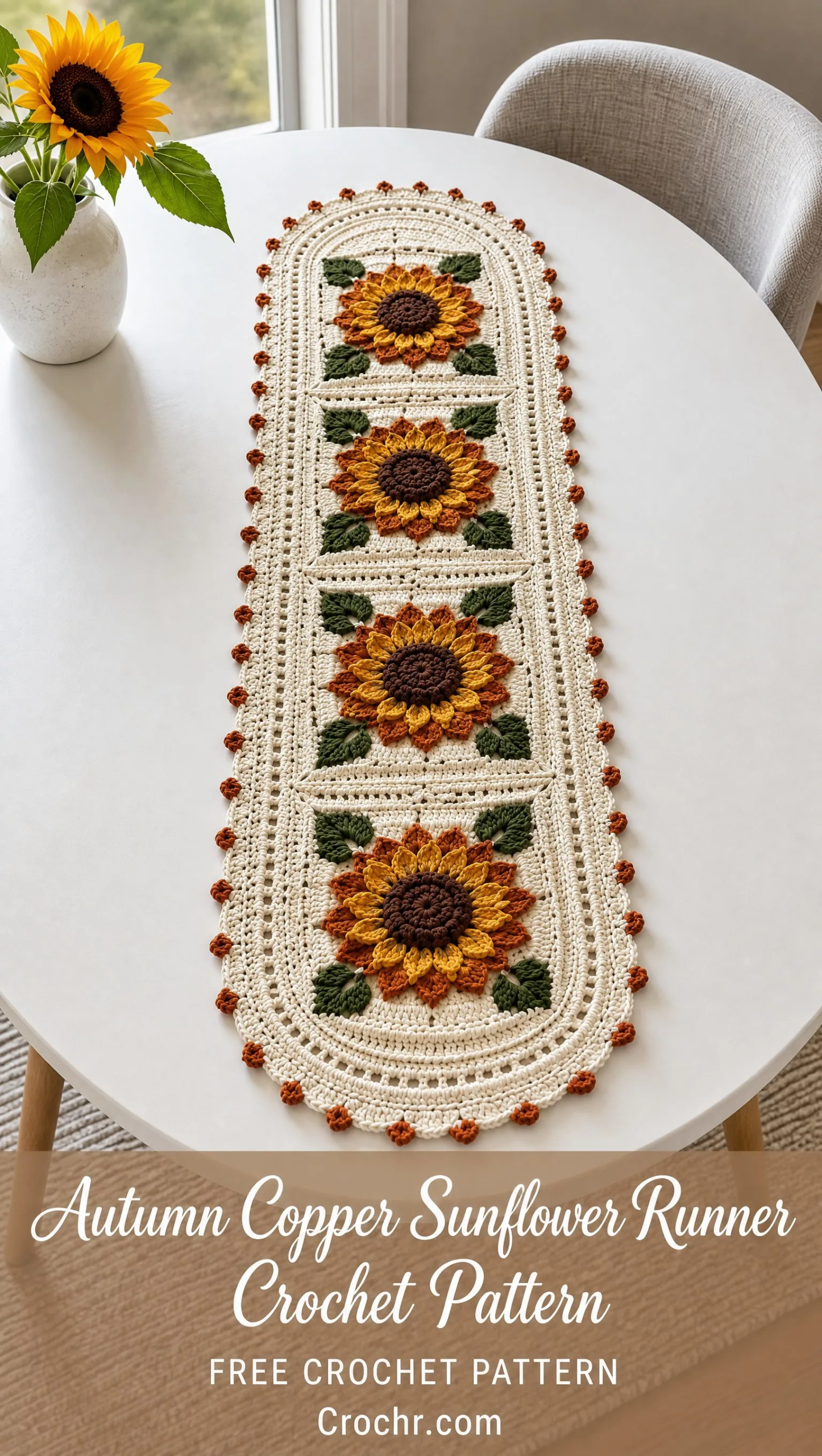
The runner sat on her table for nearly a year before I finally wrote down the pattern properly. Every time I visited, I would notice how the light caught those raised cinnamon centers differently depending on the time of day. That little detail convinced me this design deserved to be shared more widely.
Now it is ready for your hook. Whether you are decorating for fall, making a housewarming gift, or just want a project that feels a bit more special than the usual dishcloth, this table runner delivers. The construction is straightforward once you understand how the motifs fit together, and the finished piece looks far more complicated than it actually is.
Why You Will Love This Sunflower Table Runner
This crochet pattern combines several elements that make it genuinely satisfying to work. The sunflowers feature textured raised centers that pop off the background, created with simple front post stitches. The petals layer copper and mustard tones for that authentic autumn sunflower look. Deep moss green leaves frame each bloom, and the whole thing sits within elegant ivory diamond motifs.
What I appreciate most about this design is its versatility. At approximately 14 x 42 inches, it fits perfectly on a dining table, buffet, or entryway console. But the pattern is fully adjustable. Want a shorter runner for a side table? Make fewer motifs. Need something longer for a banquet table? Simply add more diamond sections. The modular construction makes customization easy.
The skill level sits at intermediate, but do not let that scare you if you are a confident beginner. If you can work double crochet (dc), half double crochet (hdc), and are willing to try front post stitches, you have everything you need. I will walk you through each technique as we go.
Materials You Will Need
Gathering your supplies before starting always makes the process smoother. Here is everything required for this autumn copper sunflower runner crochet pattern:
Yarn:
Mercerized cotton is the ideal choice here. It gives you crisp stitch definition, holds up beautifully to washing, and has a subtle sheen that elevates the finished look. The durability matters since this runner will likely see spills and need occasional cleaning.
Tools:
The blocking supplies are not optional for this project. Proper blocking transforms the diamond motifs from slightly wonky to perfectly crisp. Your finished runner will look professionally made with just 30 minutes of blocking time.
Stitch Abbreviations and Definitions
Let me define every abbreviation before we begin. If you are newer to crochet patterns, bookmark this section for quick reference.
Front post stitches deserve special mention since they create the texture in this pattern. Instead of inserting your hook through the top of a stitch, you insert it around the post (the vertical part) from front to back to front. This pushes the stitch forward, creating a raised ridge. The technique sounds tricky but becomes intuitive after a few repetitions.
Step 1: Make the Sunflower Center
We start at the heart of each sunflower. These cinnamon centers have a bumpy, realistic texture that mimics the seed head of an actual sunflower.
Using cinnamon yarn:
Round 1: Create a magic ring. Chain 2 (this counts as your first hdc), then work 12 hdc into the ring. Pull the ring closed and join with a slip stitch to the top of your beginning chain 2. You should have 12 stitches total.
Round 2: Chain 2, work 2 hdc in each stitch around. Join with a slip stitch. You now have 24 stitches.
Round 3: This is where the texture happens. Add texture by working raised stitches around each hdc from the previous round. Work front post half double crochet around each stitch. This pushes the stitches forward, creating that bumpy seed texture. Fasten off and weave in your end.
The center should measure roughly 2 inches across. If yours is significantly larger or smaller, adjust your hook size accordingly.
Step 2: Create Sunflower Petals
Now we add the gorgeous copper petals that make these sunflowers so striking. The petal construction creates dimensional, pointed petals that curve naturally.
Attach copper yarn to any stitch on the outer edge of your center.
Petal Round:
Work the following repeat around the entire center:
Slip stitch into next stitch, chain 3, work 3 dc into the same stitch, chain 3, slip stitch into the same stitch.
Repeat this sequence around to create petals. Each petal forms a little shell shape that points outward.
Adding Mustard Highlights:
Once your copper petals are complete, take your mustard yarn and add highlights using surface slip stitches. Thread the mustard yarn onto your tapestry needle or use your hook to work surface slip stitches along selected petals. I typically highlight every second or third petal, working a line of slip stitches down the center of each chosen petal. This creates the color variation you see in real sunflowers.
Fasten off and weave in ends. Set your completed sunflowers aside.
Step 3: Crochet the Leaves
Each sunflower gets 2 to 3 leaves tucked around it. These simple pointed leaves work up in minutes.
Using moss green yarn:
