

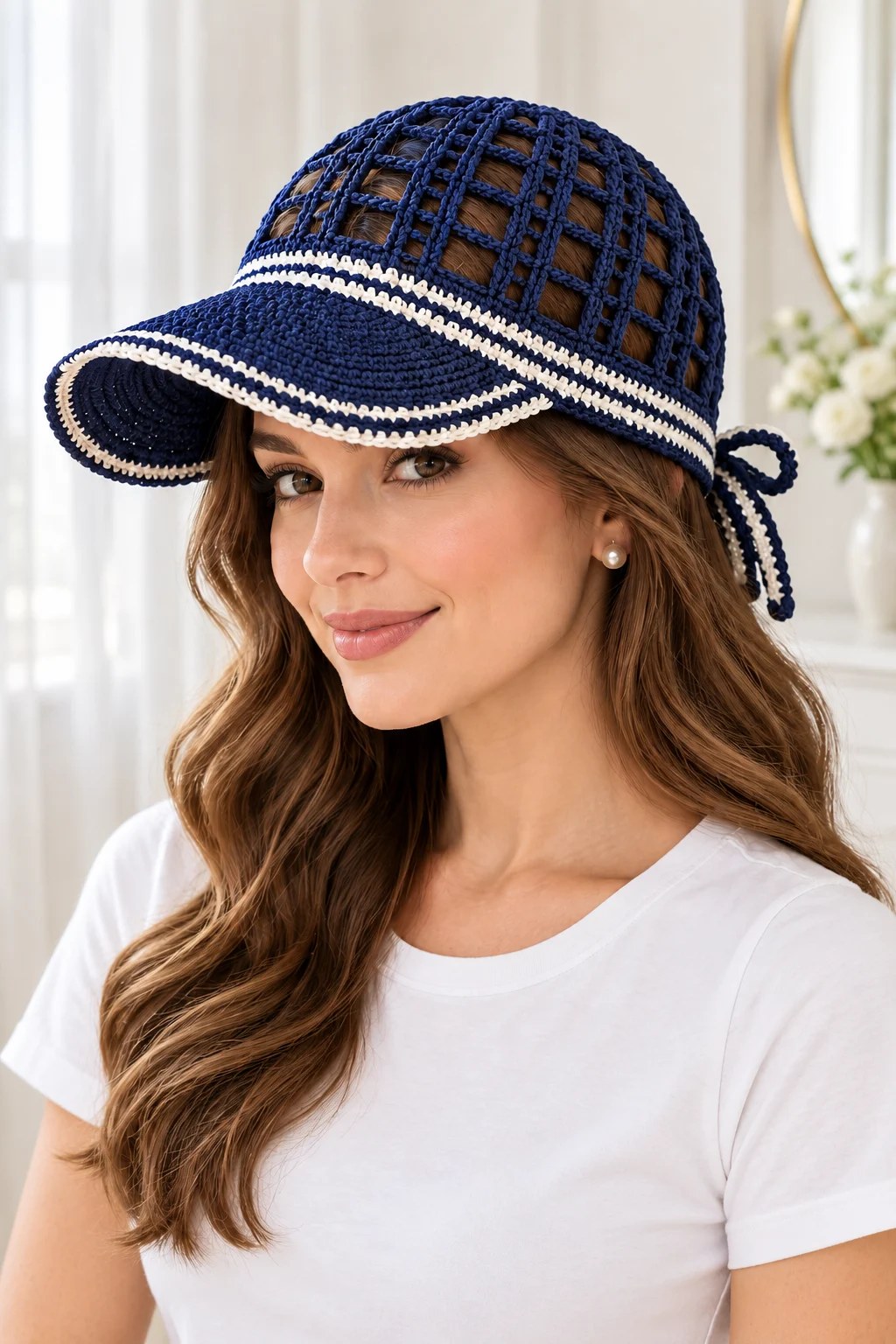
This design brings together classic nautical style with breezy, open lacework in a way that feels fresh and surprisingly wearable. The geometric ladder mesh crown keeps things light and airy while the structured double layer visor adds polish and practical sun shielding. Navy blue with crisp white edge stripes gives it that timeless coastal charm.
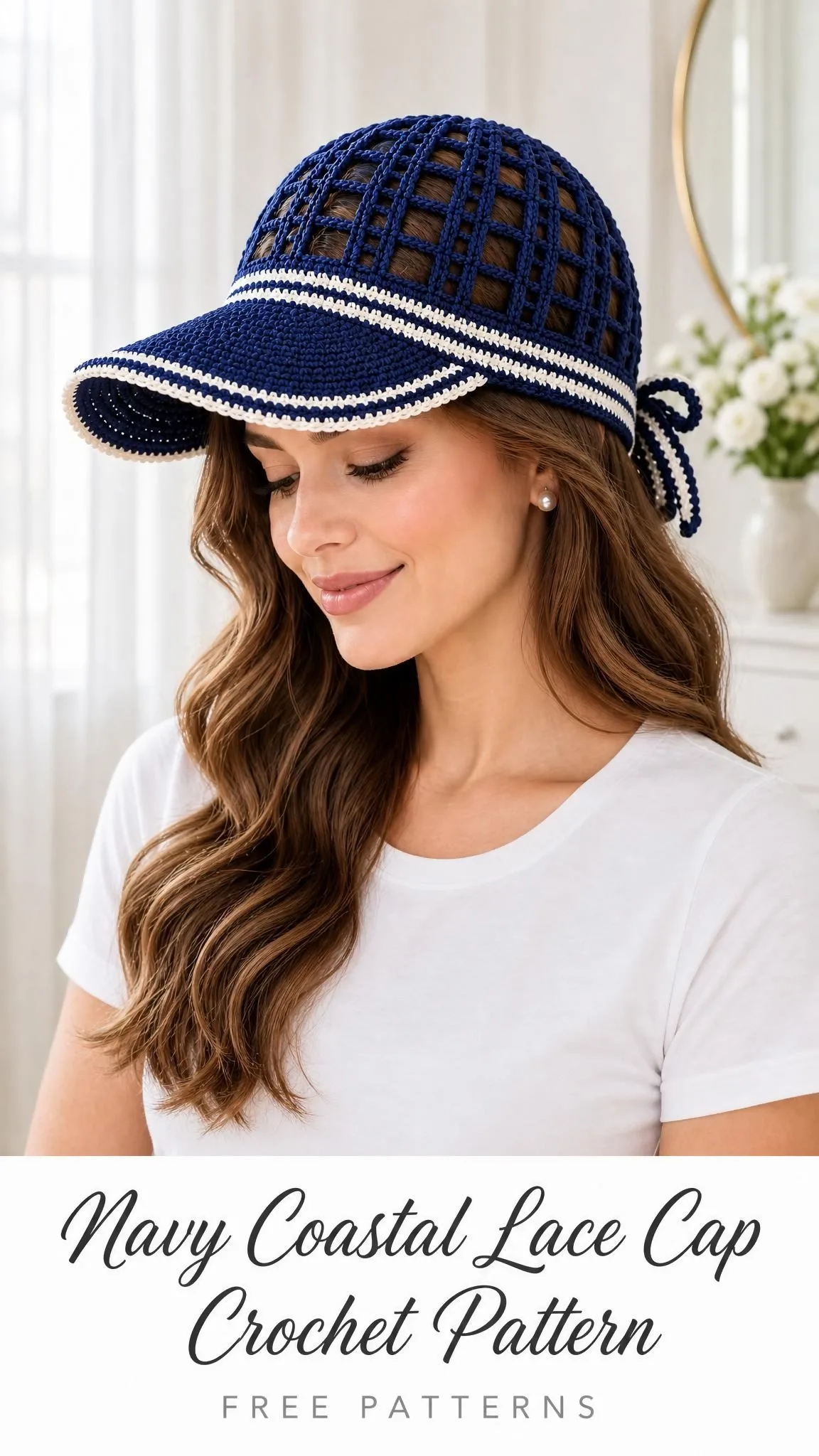
Sized for an adult head measuring 54 to 57 cm, this ponytail visor cap works up from the top down, creating a fitted silhouette that sits comfortably while leaving room for hair at the back. The rear opening with its narrow bow ties adds both function and a sweet finishing detail.
Whether you are heading to the beach, the farmer’s market, or just need something stylish for sunny days, this cap delivers. The clean lines and geometric mesh pattern make it a sophisticated accessory without being fussy. You will love how the construction comes together, and the double layer visor gives it real structure.
Why This Crochet Cap Pattern Works
The ladder mesh stitch pattern creates those signature open squares you see across the crown. This is not complicated lace work. It is simply double crochet posts separated by chain one spaces, repeated in rounds. The effect looks intricate, but once you understand the rhythm, it moves quickly.
The visor uses dense single crochet (sc) worked in rows with gradual decreases on each side. Two identical layers get stitched together with an optional flexible insert sandwiched between them. This gives the brim enough body to hold its curve without feeling stiff or heavy.
The white contrast stripes along the visor edge are worked directly into the fabric, so there is no complicated colorwork or separate pieces to attach later. Just two rounds of contrast color single crochet create that classic nautical stripe.
Skill Level
This pattern suits confident beginners and intermediate crocheters. You should be comfortable with:
- Working in joined rounds
- Double crochet and single crochet
- Decreasing with sc2tog
- Reading stitch counts and maintaining gauge
- Basic assembly and seaming
If you have made a beanie or basic hat before, you are ready for this. The mesh pattern looks fancy but follows a predictable repeat. Take your time on the first few increase rounds and the rest will flow.
Materials and Tools
Yarn:
- Smooth fingering weight cotton, approximately 200 m per 50 g
- Main color (navy blue): 100 g / 400 m
- Contrast color (white): 15 g / 60 m
- Estimated quantities include appliques and double visor
Hooks:
- 2.5 mm for crown, or size needed to obtain gauge
- 2.25 mm for visor and trim, or size needed to obtain gauge
Notions:
- Tapestry needle
- 8 stitch markers
- Scissors
- Tape measure
- Optional: washable flexible visor insert, cut 3 mm smaller than crocheted layers
- For pearl versions: 6 to 10 sew on 8 mm imitation pearls and strong sewing thread
Gauge
Getting gauge right matters here because the cap needs to fit a specific head circumference.
Crown gauge: 22 stitch positions (11 small mesh cells) x 12 rows = 10 cm
Dense visor gauge: 22 sc x 24 rows = 10 cm
The 120 position crown circumference measures approximately 54.5 cm.
Make a swatch at least 15 x 15 cm, wash and dry it as you will the finished piece, then measure the central 10 cm without stretching. Change your hook size up or down to match gauge. Record both width and height measurements.
All dimensions given are blocked targets. Cotton lace can lengthen while worn, so do not skip this step.
Finished Measurements
- Head circumference: 54 to 57 cm
- Crown depth: approximately 18 cm
- Rear opening: approximately 6 x 5 cm
- Visor: 20 x 6 cm
Abbreviations and Special Stitches
This pattern uses US crochet terminology.
- ch = chain
- st(s) = stitch(es)
- sp = space
- sl st = slip stitch
- sc = single crochet (insert hook, yarn over, pull up a loop, yarn over, pull through both loops)
- hdc = half double crochet
- dc = double crochet (yarn over, insert hook, yarn over, pull up a loop, yarn over, pull through two loops, yarn over, pull through remaining two loops)
- tr = treble crochet
- BLO = back loop only
- RS/WS = right side / wrong side
- rep = repeat
- inc = increase
- sc2tog = single crochet two stitches together (insert hook in first stitch, pull up a loop, insert hook in next stitch, pull up a loop, yarn over, pull through all three loops on hook)
Small Mesh (Flat)
Ch 3 (counts as first dc), then work to end. Work the dc into the post stitch, not the gap.
A mesh cell is one ch 1 space bounded by dc posts. Flat work with C cells has C+1 dc posts and C chains. Total positions = 2C+1.
Shell Trim
On a prepared sc edge with a multiple of 6 stitches: .
Picot Trim
.
Pattern Notes
Before you begin, read through these notes to understand how the pattern is structured.
- Turning ch 3 counts as a dc
- Ch 1 does NOT count as a sc
- Join rounds with sl st unless stated otherwise
- Flat rows turn after each row
- Joined rounds do not turn
- Brackets [ ] enclose a repeat
- Do not count joining sl sts
- Sew with RS together unless directed otherwise
- Work main fabric in navy blue
- Use white for named trims and contrast details
This document supplies one adult sample size only. Check measurements before committing your yarn. Altering stitch counts requires recalculating motif placement and shaping.
Construction Overview
Here is the roadmap for building this cap:
- Increase a circular lace top to 60 mesh cells (120 stitch positions)
- Work four closed mesh rounds
- Work five open rows leaving a rear notch
- Add the front visor
- Finish the edges
- Attach motifs and ties
Instructions
Crown Lace Disc
Round 1: Into an adjustable ring, ch 3 (counts as first dc), 11 dc; join with sl st to top of ch 3. 12 dc.
Round 2:Ch 3, ch 1; 11 times; join.12 dc + 12 ch 1 spaces; 12 cells.
Round 3: Sl st into first ch 1 space. Work [(dc, ch 1, dc, ch 1) in next space, (dc, ch 1) in each of next 1 spaces] 6 times; replace first dc with ch 3 and join. 18 dc + 18 ch 1 spaces; 18 cells.
Round 4: Sl st into first ch 1 space. Work [(dc, ch 1, dc, ch 1) in next space, (dc, ch 1) in each of next 2 spaces] 6 times; replace first dc with ch 3 and join. 24 dc + 24 ch 1 spaces; 24 cells.
Round 5: Sl st into first ch 1 space. Work [(dc, ch 1, dc, ch 1) in next space, (dc, ch 1) in each of next 3 spaces] 6 times; replace first dc with ch 3 and join. 30 dc + 30 ch 1 spaces; 30 cells.
Round 6: Sl st into first ch 1 space. Work [(dc, ch 1, dc, ch 1) in next space, (dc, ch 1) in each of next 4 spaces] 6 times; replace first dc with ch 3 and join. 36 dc + 36 ch 1 spaces; 36 cells.
Round 7: Sl st into first ch 1 space. Work [(dc, ch 1, dc, ch 1) in next space, (dc, ch 1) in each of next 5 spaces] 6 times; replace first dc with ch 3 and join. 42 dc + 42 ch 1 spaces; 42 cells.
Round 8: Sl st into first ch 1 space. Work [(dc, ch 1, dc, ch 1) in next space, (dc, ch 1) in each of next 6 spaces] 6 times; replace first dc with ch 3 and join. 48 dc + 48 ch 1 spaces; 48 cells.
Round 9: Sl st into first ch 1 space. Work [(dc, ch 1, dc, ch 1) in next space, (dc, ch 1) in each of next 7 spaces] 6 times; replace first dc with ch 3 and join. 54 dc + 54 ch 1 spaces; 54 cells.
Round 10: Sl st into first ch 1 space. Work [(dc, ch 1, dc, ch 1) in next space, (dc, ch 1) in each of next 8 spaces] 6 times; replace first dc with ch 3 and join. 60 dc + 60 ch 1 spaces; 60 cells.
Round 11:Ch 3; 59 times; ch 1, join to top of ch 3.60 dc + 60 ch 1 spaces.
