

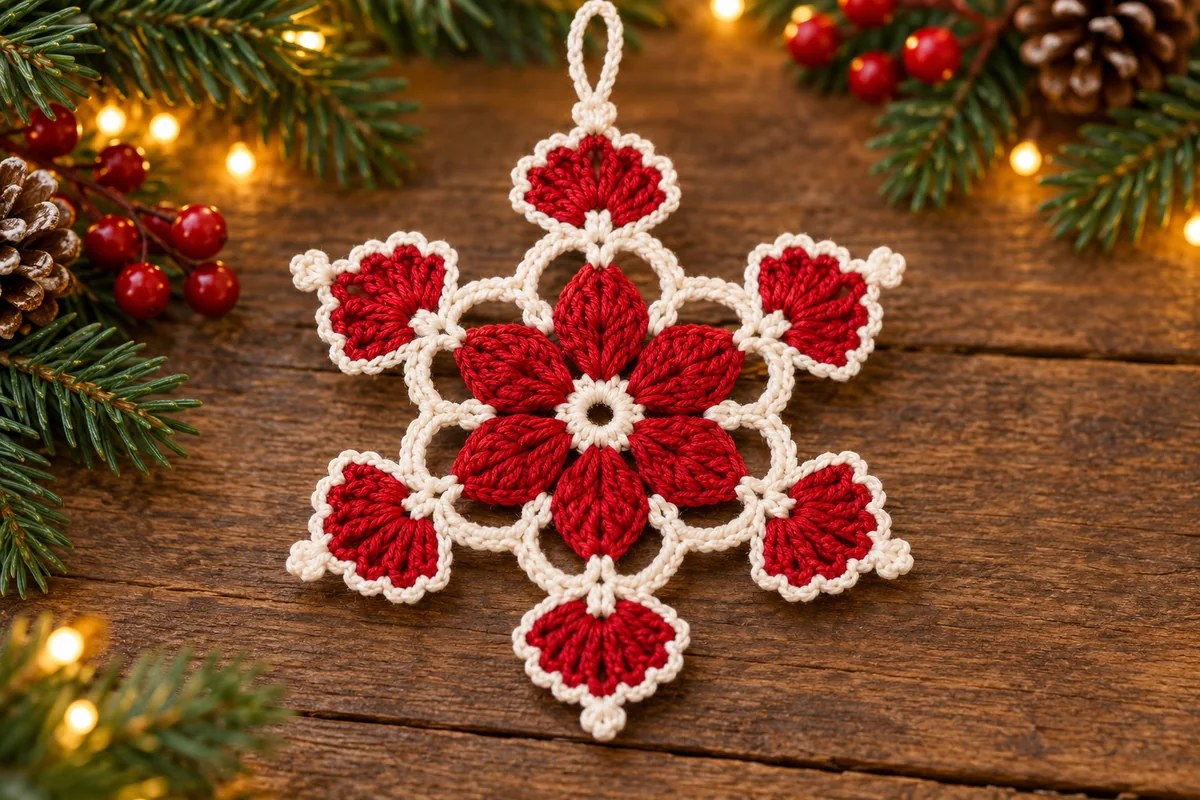
This floral crochet snowflake combines six red center petals, cream chain arches and six red fan-shaped points. A narrow cream outline and a small picot at each tip give the open ornament a crisp, contrasting finish.
The free pattern is an original interpretation inspired by the reference image, not the exact recipe in that photograph or its accompanying chart. The stitch arithmetic has been checked, but the design has not been physically crocheted or tested. Make one ornament first and adjust your materials and blocking to the fabric you produce.
Four joined rounds build the motif. The center has six clusters; the second round creates twelve arches, and the third uses alternate arches for the six points. The fourth round outlines every fan and valley, with one picot at each main tip.
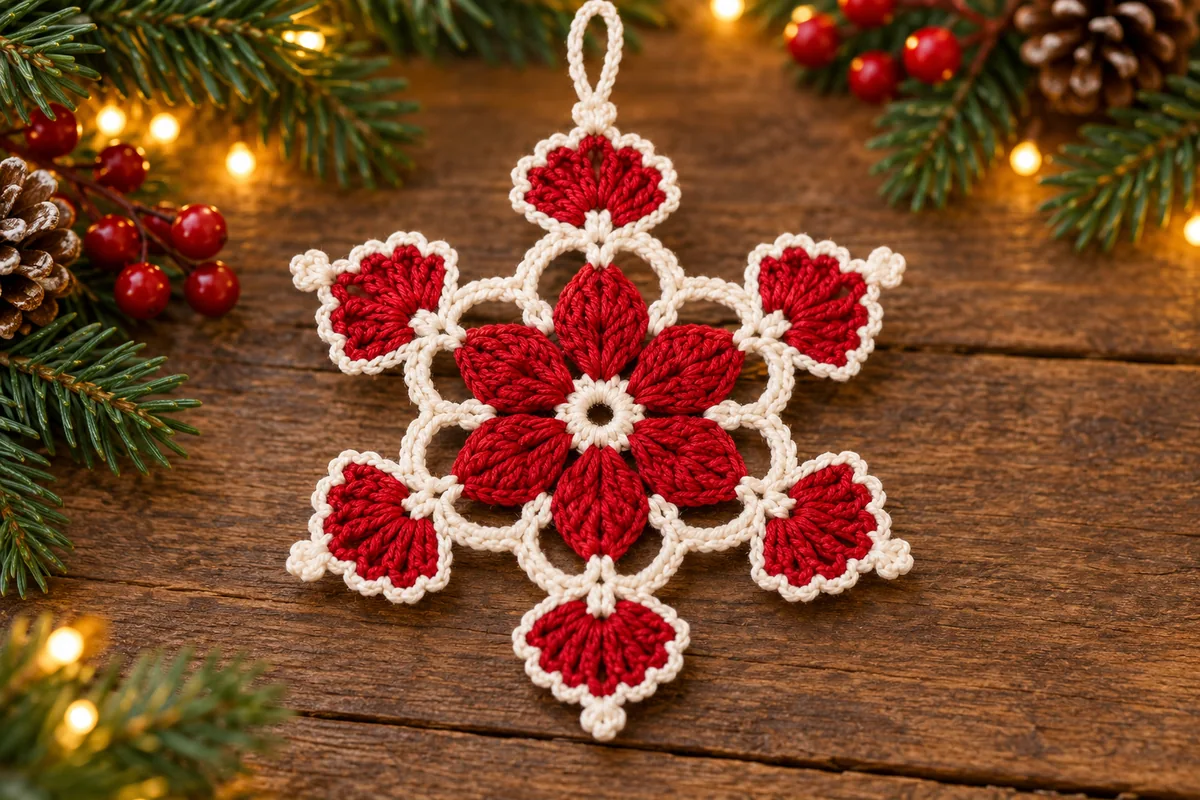
Materials for a floral crochet snowflake
- Smooth DK cotton in red and ivory or warm cream, both of the same weight.
- A 3 mm hook as a starting point, adjusted for clear stitches and relaxed chains.
- A yarn needle, scissors and removable stitch markers.
- A blocking surface and rustproof pins, if the yarn allows damp blocking.
- A separate narrow cord for hanging; optional fabric stiffener compatible with your yarn.
No measured gauge, finished diameter or yarn consumption is supplied for this untested interpretation. The yarn, hook and chain tension determine the size. Use the first motif to decide whether it suits your tree branch, gift package or garland.
The project suits a confident beginner familiar with joined rounds and unfinished double crochet stitches. Avoid changing yarn thickness between red and cream: a much thinner cream strand can pull the openwork inward, while a bulky strand can hide the red tips.
US abbreviations and special stitches
ch = chain; sl st = slip stitch; sc = single crochet; dc = double crochet; st/sts = stitch/stitches; sp = space; MR = magic ring; 3-dc cl = three-double-crochet cluster. Consult the Craft Yarn Council crochet abbreviations guide for standard US stitch names.
Three-double-crochet cluster
Yarn over, insert the hook into the indicated location, yarn over and draw up a loop, then yarn over and pull through two loops. Leave the remaining loops on the hook. Repeat this unfinished dc twice more into the same location. Four loops remain; yarn over and pull through all four. The three legs have one closed top, counted as one cluster.
Beginning cluster
Ch 2 to replace the first unfinished dc leg. Work two unfinished dc into the ring, leaving the final loop of each on the hook. With three loops remaining, yarn over and pull through all three. This makes the first cluster; the ch 2 is part of that cluster, not an additional stitch.
Fan and picot
A fan is (3 dc, ch 3, 3 dc) in one indicated arch. Its six dc have separate tops; they are not closed together. A picot is ch 3, then sl st in the first of those three chains. The picot does not add another sc to the edging count.
Work in joined rounds without turning. Fasten off at the end of each round and attach the next color where stated. A beginning ch 1 never counts; the beginning ch 3 in Round 3 counts as the first dc. Color-attachment and final joining slip stitches are excluded from the round totals.
Floral crochet snowflake: the four rounds
Round 1: six red cluster petals
With red, make a MR. Work the beginning cluster described above, then ch 3. Repeat five times. Close the ring gently and join with a sl st to the closed top of the beginning cluster. Fasten off red.
Count: 6 clusters and 6 ch-3 spaces. The last ch 3 makes the sixth space. Do not add another space after joining. Spread the clusters around the ring without pulling the chain arches tight.
Round 2: twelve cream arches
Join cream with a sl st in the top of any cluster. Ch 1 and sc in that same top, then ch 5. Sc around the following ch-3 space and ch 5. Repeat five times. Join to the first sc and fasten off cream.
Count: 12 sc and 12 ch-5 arches. Six sc sit on cluster tops; the other six sit in the spaces between clusters. Each original petal section therefore contributes two new arches, not one. Mark the first arch if you need help tracking them.
