

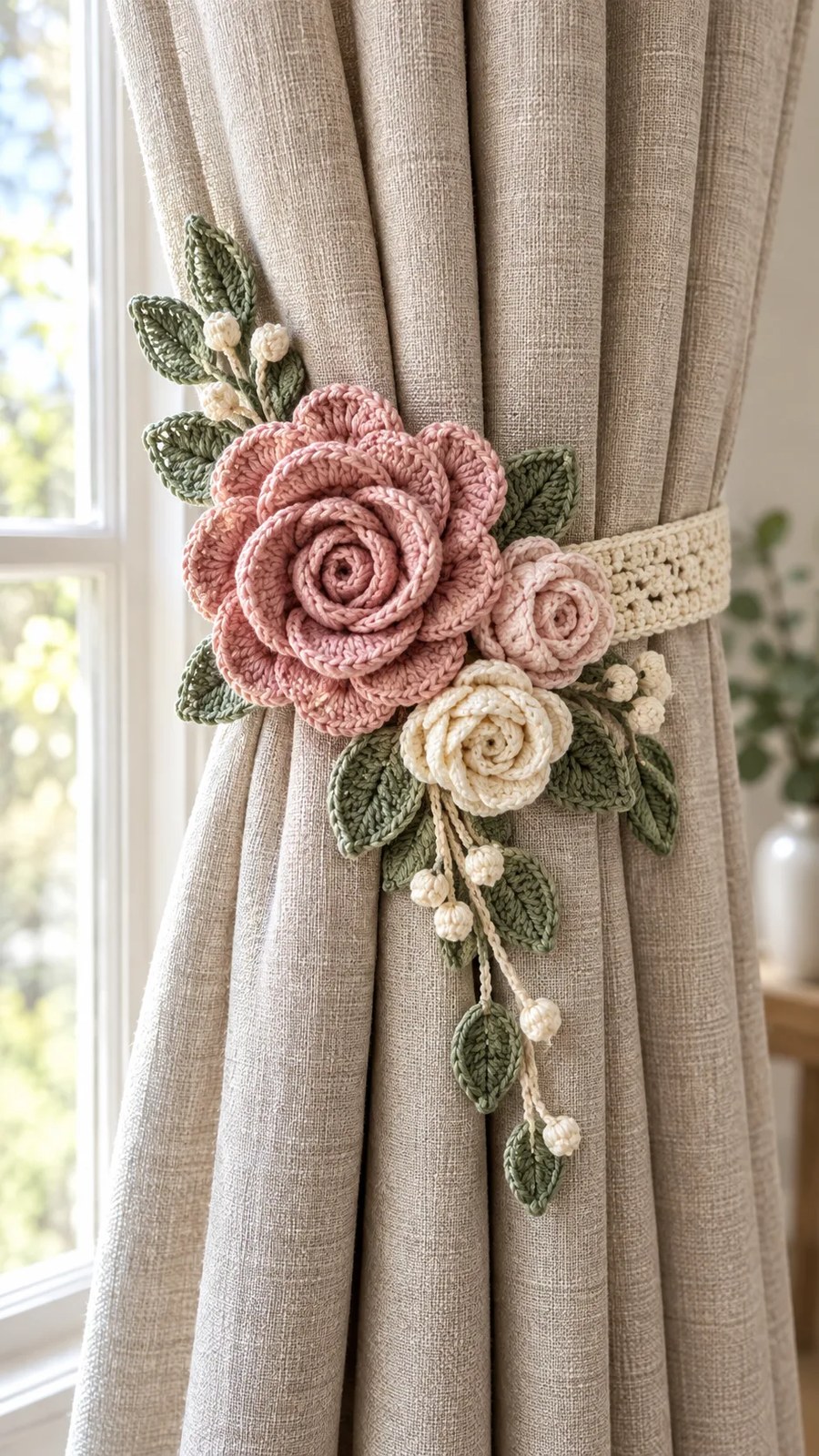
A beautiful handmade curtain tieback can completely transform a room. This romantic floral design features three rolled spiral roses, delicate eucalyptus leaves, tiny bobble buds, and trailing cords that drape elegantly against your curtains. Whether you want to add a soft, feminine touch to your bedroom or create a thoughtful housewarming gift, this project delivers stunning results.
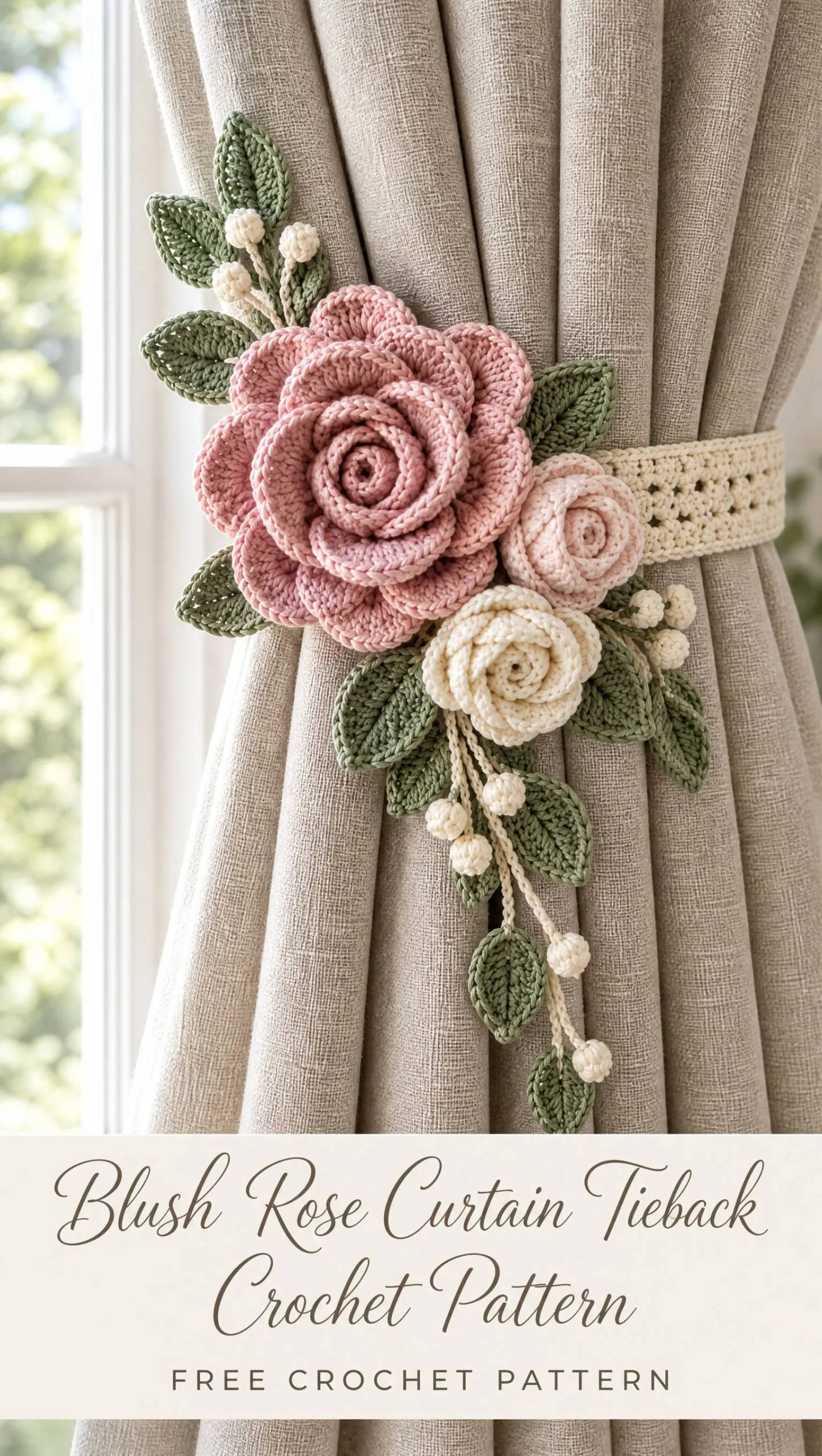
The construction is simpler than it looks. You will work basic stitches like single crochet, half double crochet, double crochet, and treble crochet. The roses are made as flat strips that you roll into spirals, which is much easier than working in complicated rounds. The whole tieback comes together in manageable pieces that you assemble at the end.
This pattern suits confident beginners and intermediate crocheters. If you can chain, work basic stitches, and sew pieces together, you have everything you need. The finished tieback measures approximately 42 cm long and fits most standard curtains with room for adjustment.
Materials You Will Need
Gathering your supplies before you start makes the whole process smoother. Here is everything the pattern calls for:
Yarn:
Tools:
Fastening Hardware:
Optional:
Finished Dimensions
Understanding the sizes helps you plan your project:
| Component | Size |
|---|---|
| Tieback band | Approximately 42 cm long x 3.5 to 4 cm wide |
| Large dusty pink rose | Approximately 10 to 11 cm diameter |
| Small blush rose | Approximately 5.5 to 6.5 cm diameter |
| Small ivory rose | Approximately 5.5 to 6.5 cm diameter |
| Leaves | Approximately 4.5 to 6 cm long |
Gauge Information
Gauge is not critical for this project, but here is a reference point. Working in half double crochet (hdc), you should get approximately 20 stitches and 12 rows per 10 cm with DK weight cotton and a 3.5 mm hook.
If your band turns out slightly longer or shorter, do not worry. You will wrap it around your specific curtain and adjust the fastener placement to fit perfectly.
Abbreviations and Stitch Definitions
Let me walk you through each abbreviation used in this pattern:
Part 1: Crochet the Cream Tieback Band
The band forms the foundation of your tieback. It wraps around gathered curtain fabric and fastens invisibly at the back. You work it lengthwise in rows so it lies flat and smooth.
Foundation: With cream yarn and your 3.5 mm hook, ch 86 loosely. This gives approximately 42 cm with the suggested yarn and hook.
Row 1: Hdc in 2nd ch from hook and in each ch across. Ch 1, turn. (85 hdc)
Row 2: Working through the back loop only, hdc in each st across. Ch 1, turn.
Rows 3 through 6: Repeat Row 2. Your band should measure about 3.5 to 4 cm wide after these rows.
Edging Round: Ch 1. Sc evenly around all four sides, placing 2 sc in each corner. Join with sl st to first sc. Fasten off and weave in ends.
Adding the Fastener: Wrap the band around your curtain at the height where you want it to sit. Mark where the ends overlap. Sew one flat snap or a small hook and eye pair to the wrong side so the fastening hides completely behind the curtain. If you prefer a button closure, make a tiny chain loop at one end and sew the button inside the opposite end.
Fit Check Tip: The band should hold the curtain gently without crushing the folds. If it feels too tight, add a crocheted chain loop at one end for extra length. If it feels too loose, move the snap inward.
Part 2: Large Dusty Pink Spiral Rose
This gorgeous focal flower looks intricate, but you simply crochet a long strip with graduated shells and roll it up. The shells start small and grow larger, creating natural petal layers.
Foundation: With dusty pink yarn, ch 61.
Row 1: Sc in 2nd ch from hook and in each ch across. (60 sc) Turn.
Row 2 (Petal Base): Ch 1, sc in first st. Ch 2, sk 1 st, sc in next st. Repeat from to across, ending with sc in last st. You should have a line of ch 2 spaces.
Row 3 (Graduated Shells): Work into each ch 2 space as follows:
Sl st into each intervening sc as needed to keep shells distinct. Fasten off with a 60 cm sewing tail.
Rolling the Rose: Beginning at the small shell end (the hdc shells), coil the strip tightly for the first 2 to 3 turns. Then slightly loosen the roll so the outer petals open naturally and look like real rose petals. Keep the straight foundation edge aligned at the base as you roll.
Securing the Rose: Thread the long tail through the foundation edge from side to side, catching every layer. Make several firm passes across the base. Knot securely and weave in the end.
