

356 shares
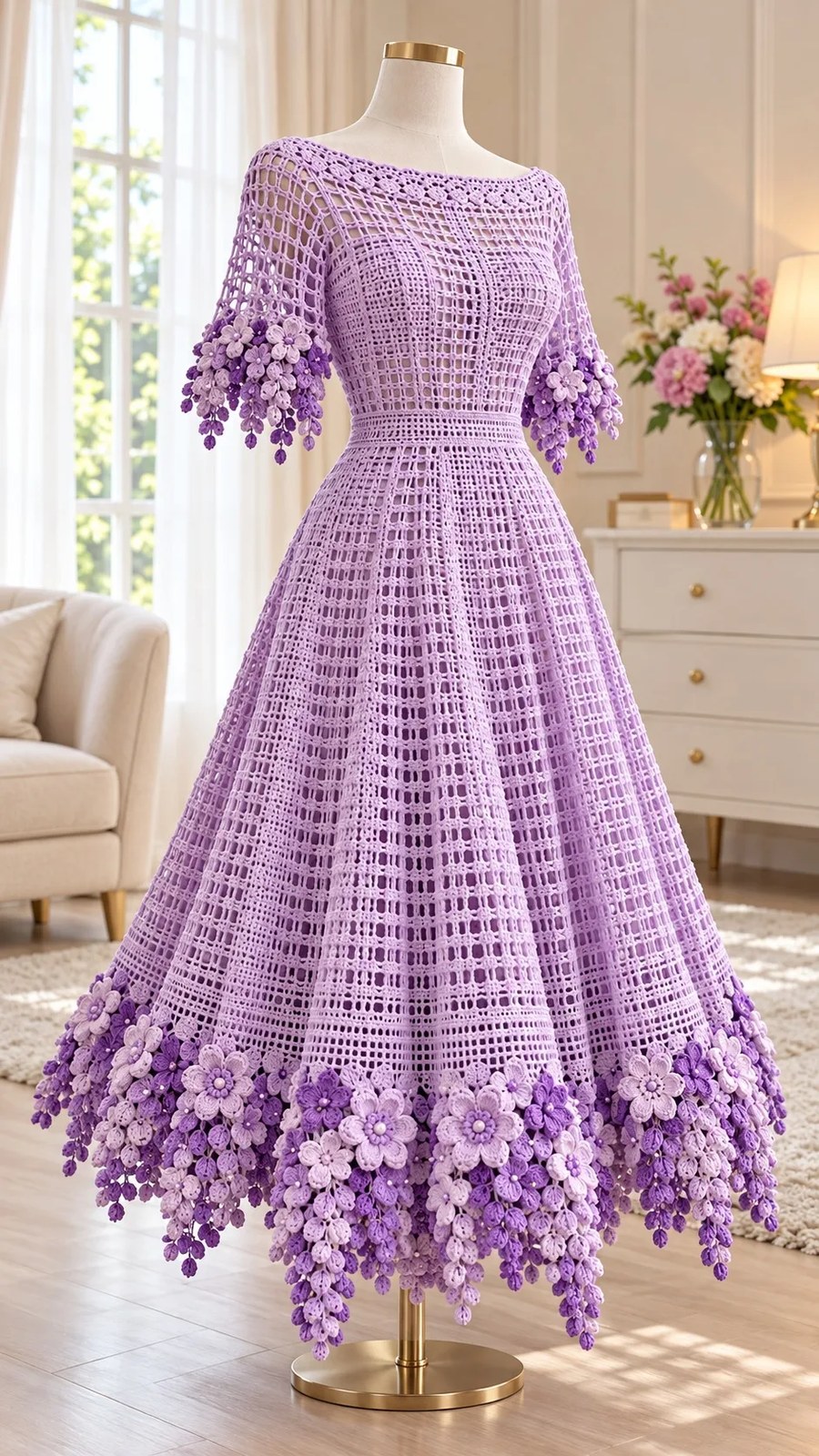
A filet crochet dress with a boat neckline, flared skirt, and cascading wisteria flower clusters at the hem and sleeves. This pattern uses double crochet and chain stitches throughout. The construction involves flat panels joined at the waist, with separately made sleeves attached at the armholes.
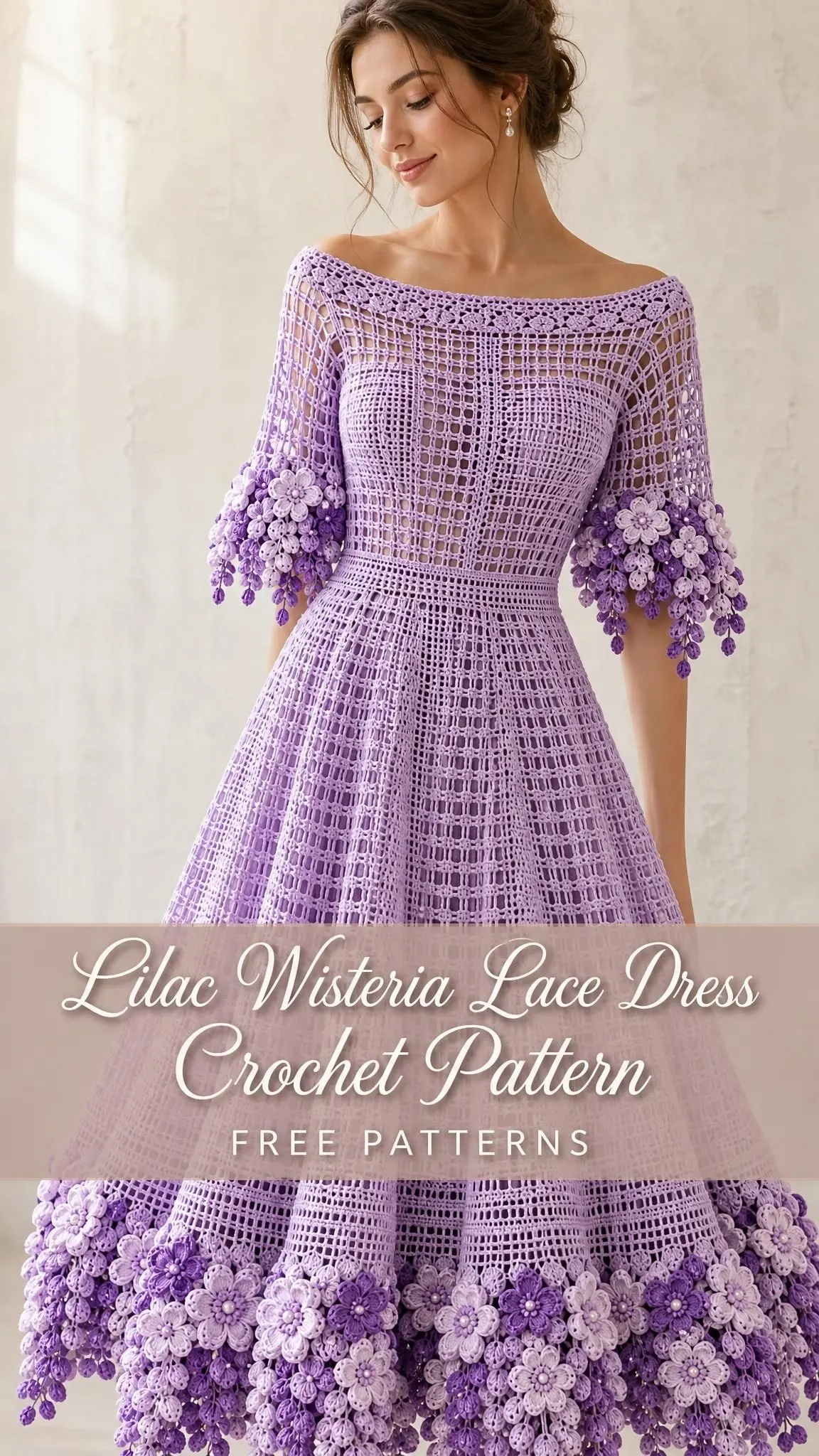
This is an intermediate to advanced project that creates a stunning statement piece. The finished bust measures approximately 100 cm, fitting a body bust of 90 to 94 cm with 6 to 10 cm of ease.
Sport weight cotton yarn in pale lilac forms the main body, while violet and lavender accents bring those beautiful wisteria flower clusters to life.
About This Design
The Lilac Wisteria Lace Dress brings together classic filet crochet technique with romantic floral embellishments. The openwork grid pattern creates an airy, elegant silhouette that flows beautifully when worn. Those dangling wisteria clusters at the hem and sleeve ends transform a simple lace dress into something truly eye catching.
The bodice features a wide boat neckline created by leaving the central stitches unworked and shaping each shoulder separately. This gives a flattering, sophisticated look without complicated neckline shaping techniques.
Six gored skirt panels create the lovely flared shape. Each panel starts narrow at the waist and gradually widens toward the hem through simple end of row increases. When joined together, these panels create a full 240 cm hem circumference that moves gracefully.
The elbow length sleeves are worked as simple rectangles. You can style them as subtle puff sleeves by gathering slightly at the shoulder, or leave them loose for a bell sleeve effect with the scalloped border.
Materials Needed
Yarn Requirements:
- Main color (pale lilac): 944 g, approximately 2832 m of smooth sport weight cotton at 300 m per 100 g
- Accent colors (violet and lavender): 250 g total, approximately 750 m, split evenly between the two shades
Use yarns of equal thickness across all colors. The amounts listed include a planning allowance, but you should confirm your actual needs by weighing your gauge swatch.
Hooks:
- 3.5 mm hook for the main fabric
- 3.0 mm hook for firm borders and the belt
Adjust hook sizes as needed to meet the blocked gauge.
Notions:
- Tapestry needle
- Removable stitch markers
- Tape measure
- Scissors
- Blocking mats and rust resistant pins
- Sewing needle and matching thread
- 40 cm dress zipper
- 1 m of 10 mm cotton tape for waist stabilization
- Optional: 6 mm sew on pearls for flower centers
Additional Item:
A separate opaque slip is needed for wearing this openwork dress.
Gauge
Getting gauge right is essential for this dress to fit properly.
Blocked main stitch gauge: 5 filet cells and 10 rows equals 10 x 10 cm. One repeat measures approximately 2.00 cm wide.
Border gauge: 20 single crochet (sc) stitches and 24 sc rows equals 10 cm.
Measure away from edges for the most accurate reading. This gauge governs every count in the pattern. Change your hook or yarn if you cannot achieve it without distorting the fabric.
Making Your Swatch:
Chain 22 (using N equals 10 in the foundation formula). Work at least 20 rows of the filet pattern. Wet block your swatch and dry it flat for 24 hours. Then hang it for 12 hours to check for cotton growth, which is common with this fiber.
Measure the central 10 cm and recheck the length after hanging. Keep this swatch for washing and colorfastness tests before starting the full project.
Abbreviations and Special Stitches
- ch = chain
- sc = single crochet (insert hook, yarn over, pull through, yarn over, pull through both loops)
- hdc = half double crochet
- dc = double crochet (yarn over, insert hook, pull through, yarn over, pull through two loops twice)
- tr = treble crochet
- sl st = slip stitch
- st(s) = stitch(es)
- sp = space
- RS/WS = right side/wrong side
- BLO = back loop only
- rep = repeat
Parentheses group stitches worked in one place. Brackets identify a repeated sequence. N represents the number of horizontal motif repeats in a piece.
Understanding the Filet Cell
A filet cell consists of chain 1 followed by a double crochet. It spans one skipped foundation chain or the previous chain 1 space. A row with N cells contains N plus 1 double crochets and N chain 1 spaces. The beginning chain 3 counts as the first double crochet.
Foundation Row (Not Counted as a Pattern Row)
Chain 2N plus 2. Single crochet in the second chain from the hook and across, giving you 2N plus 1 single crochets.
Row 1 Setup
Chain 4, turn (this counts as dc plus ch 1). Skip the first sc and the next sc, then dc in the next sc. Work N minus 1 times.
Count: N cells, N plus 1 dc.
Plain Filet Row (Row 2 and All Following Plain Rows)
Chain 4, turn (counts as dc plus ch 1). Double crochet in the next dc. Work to the end, placing the last dc into the third chain of the beginning ch 4.
Count: N cells, N plus 1 dc.
Increase One Cell at Row End
After the final dc, chain 1 and dc again in that same final stitch.
Count: N plus 1 cells.
On the next row, treat the added cell as a normal cell. Alternate which edge receives increases by increasing only at the end of the designated row.
Construction Overview
This dress comes together in a logical sequence. Make and block the two bodice panels first, then shape the neckline shoulders. Create all six skirt panels. Make two sleeve rectangles if including sleeves.
Join the shoulders and attach the sleeves. Close the side seams, leaving the zipper opening on the left side. Join the skirt panels into a ring and gather the top edge to fit the bodice waist. Add the belt, borders, and floral decorations last.
Pattern Instructions
Back Bodice
With pale lilac and your 3.5 mm hook, work the foundation with N equals 25. You will work upward from the waist.
Row 1: Work the foundation row. Count: 25 filet cells.
Rows 2 through 37: Work the plain filet recipe row. Count: 25 filet cells per row.
After completing Row 37, mark the central 9 repeats as the back neck opening. Work the outer 8 repeats at each side separately, restarting yarn at the outer edge or neck edge as required by row direction. Leave the marked center unworked.
At a lattice boundary, retain the border dc shared with the neighboring repeat. It serves as an edge, not an additional repeat.
Rows 38 through 40, each shoulder: Continue the recipe over the outer 8 repeats only. Count: 8 filet cells per shoulder.
Front Bodice
Begin exactly as the back with N equals 25. The front is worked as one panel. Any decorative button placket is applied later and does not open.
Row 1: Work the foundation row. Count: 25 filet cells.
Rows 2 through 35: Work the plain filet recipe row. Count: 25 filet cells per row.
Leave the central 9 repeats unworked. Work each shoulder separately over 8 repeats. This creates the square boat neckline.
Rows 36 through 40, each shoulder: Continue the recipe row over this shoulder only. Count: 8 filet cells per shoulder.
