
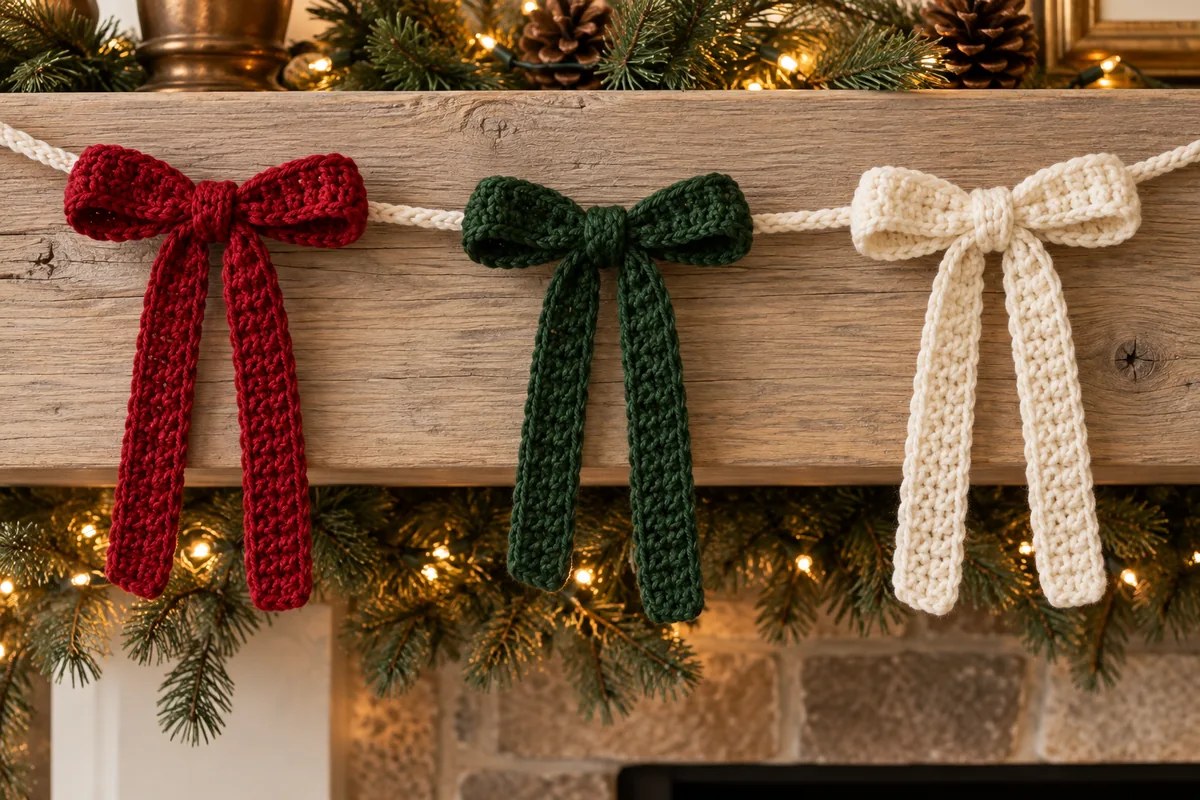
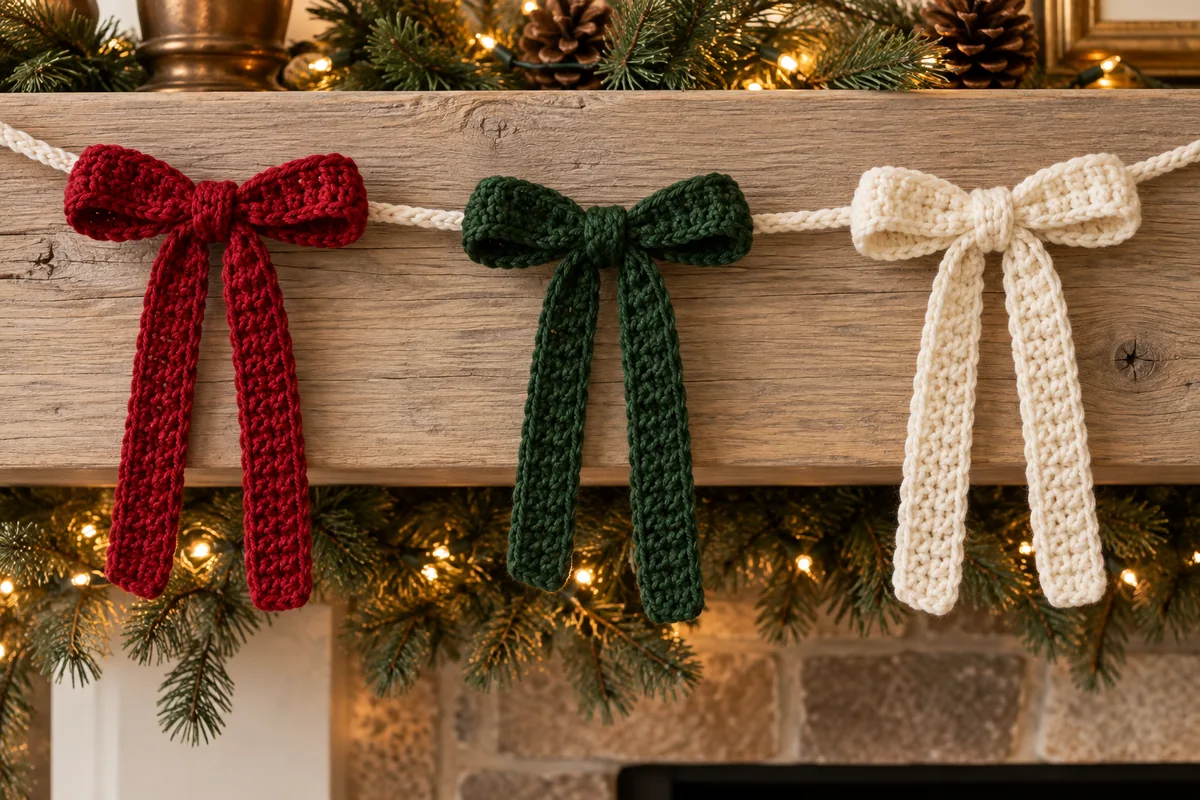
Christmas crochet bows bring a little softness to a wooden mantel, a wrapped parcel or a plain evergreen branch. Red, forest green and ivory keep the look close to the reference: open loops at the top, a small knot in the middle and two narrow tails hanging below.
This version starts with one long crochet ribbon. Two rows of half double crochet make a slim band, and working the second row in the back loop adds a gentle ridge. The bow shape comes from tying that finished ribbon rather than sewing a wide rectangle into a bow.
Make a single bow for a gift, or repeat the same ribbon in three colors for a garland. For another decoration with a soft ivory texture, the leaf point crochet star works well beside these long tails.
One ribbon makes the loops and tails
The reference suggests narrow, textured bows displayed in a row. This original interpretation uses separate tied ribbons attached to a supporting cord; it does not reproduce any interlinked construction in the photograph. The styling images show the intended look, while the written instructions define the two-row ribbon.
The stitch arithmetic is checked, but no physical sample, measured gauge, finished dimensions or yarn consumption is supplied. Make one ribbon with your chosen yarn before planning a matching set. Its flexibility matters more than a particular hook number: it needs to bend around a knot without becoming a bulky bundle.
Materials for Christmas crochet bows
- Smooth medium-weight yarn in red, forest green or ivory. Use the same yarn type and thickness for a coordinated set.
- A 4 mm crochet hook as a starting point, adjusted to the yarn label and the fabric you obtain.
- Scissors and a blunt yarn needle.
- Removable stitch markers for the row ends and for counting longer sections.
- Matching sewing thread and a needle, or a short length of matching yarn, to secure the knot.
- A separate cotton cord for a garland, if desired.
A smooth plied yarn makes the back loops easier to identify. Cotton gives a defined edge; a soft acrylic or wool blend may bend more readily when you tie it. Compare the fabrics before making all three colors, and follow the yarn label for cleaning and blocking.
Keep the ribbon narrow. Extra rows can make the center knot much thicker than the loops, particularly in a firm cotton yarn. If you choose a heavier yarn, assess a small two-row strip first instead of assuming the same hook will give a flexible bow.
US terms and the two stitches you need
ch = chain; hdc = half double crochet; BLO = back loop only; st/sts = stitch/stitches. These instructions use US terminology. The Craft Yarn Council crochet abbreviation guide is a useful reference for standard stitch names.
Half double crochet
Yarn over, insert the hook in the indicated chain or stitch, yarn over and pull up a loop. You now have three loops on the hook. Yarn over once more and pull through all three loops to complete one hdc.
Find the back loop after turning
The top of each stitch looks like a V. With the work turned and the next row facing you, the strand farther from you is the back loop. Insert under that strand only in Row 2. Leave the nearer strand unworked to form the ridge.
Half double crochet also has an extra horizontal strand below its top V. That third loop is not the back loop specified here. Locate the two strands of the actual stitch top before inserting the hook.
The turning ch 1 never counts as a stitch. There are no joined rounds, increases, decreases or slip-stitch borders in this ribbon. Work flat and turn once between the two rows.
Christmas crochet bows: the two-row ribbon pattern
Foundation: chain 101
Make a slip knot and ch 101. Keep the chains relaxed enough for the hook to pass through them without forcing it. Count from the first chain above the slip knot; the loop on the hook is not a chain.
The first chain skipped in Row 1 provides turning height. The other 100 chains each receive one hdc. For counting, place a marker every 20 chains and check the complete foundation before you start the row.
Row 1: work 100 half double crochet stitches
Hdc in the second chain from the hook, then hdc in each remaining chain to the slip-knot end. Work under the top strand of each foundation chain consistently. Do not add a stitch into the slip knot.
Count: 100 hdc. There are 101 foundation chains minus one skipped chain. Mark the first and last hdc so the ends remain easy to recognize in the next row.
Row 2: work back loop only
Ch 1 and turn. Hdc BLO in the first hdc, then hdc BLO in each of the remaining 99 hdc. Work the last stitch into the marked final hdc, leaving the turning chain unworked.
Count: 100 hdc. Every stitch from Row 1 receives exactly one stitch. Fasten off and weave both ends through the backs of several stitches, changing direction before trimming. Avoid pulling either end into a tight curl.
